ACLS Blogs

Who Needs BLS Certification? A Job-by-Job Requirements Guide

Type "does a dental hygienist need BLS" or "do teachers need CPR certification" into a search bar and you will find a scattered mess of forum answers, outdated blog posts, and conflicting opinions. That is because the honest answer to who needs BLS certification depends entirely on the job, the employer, and sometimes the state - and most articles only cover one occupation at a time.


This guide consolidates the question into a single reference. We will walk through the roles that are almost always required to hold Basic Life Support certification, the roles where it is strongly recommended but not always mandatory, and the roles where a shorter standard CPR course is actually the more appropriate fit. If you are trying to figure out what your job, your license, or your employer actually expects of you, start here.


Part of the confusion comes from where people look for answers. A job board post might casually mention "CPR certification preferred" while the actual state licensing rule underneath it specifies a full BLS provider card, and a hospital's internal policy can be stricter than either one. Rather than treating every occupation as its own mystery, it helps to sort roles into three practical buckets: jobs where BLS is essentially assumed, jobs where it depends heavily on the specific employer or state, and jobs where a standard CPR course is genuinely the better fit. The rest of this guide walks through each bucket in order.


What BLS Certification Actually Covers

Basic Life Support (BLS) certification is a healthcare-provider-level course built around high-quality CPR for adults, children, and infants, AED use, relief of choking, and team-based resuscitation skills such as coordinating compressions and ventilations with other rescuers. It is designed for people who are expected to respond to a cardiac or respiratory emergency as part of their job duties, often inside a clinical environment where they may be working alongside other trained responders.


That distinction matters because BLS is not the same thing as a general "CPR and First Aid" class aimed at the public. BLS assumes a healthcare context: it covers multi-rescuer resuscitation, high-performance team roles, and scenarios you are more likely to encounter in a hospital, clinic, or emergency response setting. A standard CPR/AED course, by contrast, is built for a single lay rescuer responding to an emergency in public, at work, or at home. Both teach the same core compressions-and-airway skills, but the depth, scenarios, and intended audience differ - which is exactly why so many non-clinical employers ask for "CPR certification" rather than "BLS certification," and why job seekers get conflicting answers when they search for their specific title.


Jobs That Almost Always Require BLS Certification

These are the roles where BLS certification is a standard condition of licensure, employment, or clinical placement. If your job title is on this list, you should assume BLS is required unless your specific employer tells you otherwise.


Nurses and Nursing Students

Registered nurses and licensed practical nurses are the clearest example of a role where BLS certification is essentially universal. Hospitals, skilled nursing facilities, home health agencies, and outpatient clinics require current BLS before a nurse can start patient-facing work, and nursing schools typically require it before students begin clinical rotations. Because nurses are frequently first on the scene of a decompensating patient, employers treat BLS as a non-negotiable baseline rather than a nice-to-have. Nurses working in higher-acuity specialties, such as the emergency department, ICU, or telemetry floor, are often expected to hold ACLS on top of BLS, since those units respond to full cardiac arrest events far more often than a general medical-surgical floor.


If you are specifically weighing whether an entry-level nursing position requires certification before your first day, we have a dedicated breakdown in Is BLS Certification Necessary for Entry-Level Nursing Jobs?, which digs into hiring timelines, new-grad exceptions, and how facilities handle candidates who are certified but still waiting on their license. This article, by comparison, is meant to answer the broader "which jobs need this" question across every role, not just nursing.
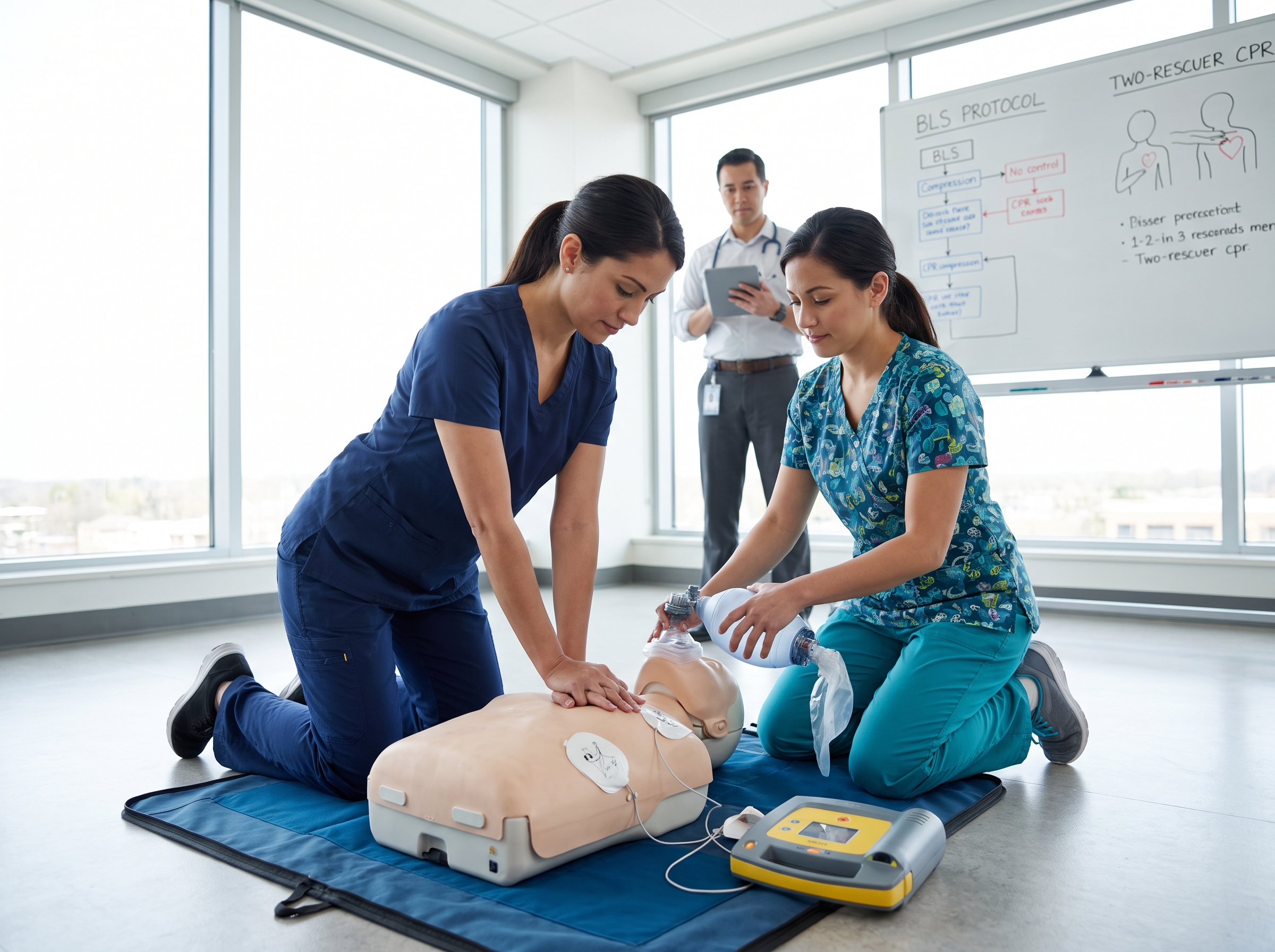
Nurse and nursing assistant practicing two-rescuer CPR during BLS training


CNAs and Nursing Assistants

Certified nursing assistants and patient care technicians work in direct, hands-on contact with patients who are often older, medically fragile, or recovering from surgery - exactly the population most likely to experience a cardiac or respiratory event. Most state CNA programs and long-term care facilities require BLS certification as part of onboarding, and many renew it on the same two-year cycle as the nursing staff they support. If your CNA program did not require it up front, expect your first employer to.


Medical Assistants

Medical assistants working in physician offices, urgent care centers, and outpatient specialty clinics are usually required to hold BLS certification, particularly in practices that perform procedures, administer injections, or handle patients under sedation. Even in lower-acuity primary care settings, BLS is commonly listed as a job requirement because medical assistants are frequently the staff member closest to a patient when a reaction or emergency begins. Many medical assisting certificate programs now build a BLS module directly into the curriculum so graduates arrive at their first job already credentialed.


Dental Staff: Dentists, Hygienists, and Dental Assistants

Dental offices administer local anesthesia, sedation, and nitrous oxide, all of which carry a small but real risk of an adverse cardiac or respiratory event chairside. As a result, most state dental boards require dentists, hygienists, and often dental assistants to maintain current BLS certification as a condition of licensure or continued employment, and many offices run mock emergency drills to keep the whole team ready, since a chairside emergency leaves little time to locate equipment or assign roles on the fly. For a closer look at how this plays out across a dental practice, see The Importance of BLS & ACLS for Dental Practices.


Pharmacists and Pharmacy Staff

Pharmacist BLS requirements vary more than most other roles on this list. Retail pharmacists who administer immunizations are frequently required to hold current BLS or an equivalent immunizing-pharmacist certification, since anaphylaxis is a recognized (if rare) risk after vaccination. Clinical and hospital pharmacists, particularly those who round with code teams or work in acute care, are increasingly expected to carry BLS as well, and some pursue ACLS to participate more actively in resuscitation events, including preparing and verifying code-cart medications during an active response. We cover this expanding role in Clinical Pharmacists and ACLS: Expanding Your Role in Code Response Teams.


Physical and Occupational Therapists

PTs and OTs work with patients during physically demanding activity - ambulation, strength training, cardiac rehab - which is precisely when an underlying cardiac issue is most likely to surface. Hospital-based and outpatient rehab employers commonly require BLS certification for both therapists and therapy assistants, and many cardiac and pulmonary rehab programs will not credential a therapist without it, since patients in these programs are, by definition, being monitored for exercise-induced cardiac symptoms. We break down exactly which practice settings require it in The Benefits of BLS and ACLS Certification for Physical Therapy Practice Staff.


Roles Where BLS Is Common but Not Always Mandatory

The next group of roles sits in a gray area. BLS certification is not universally required by law or licensure, but it is increasingly requested by employers, and the underlying skills are directly relevant to the population being served. In these roles, the deciding factor is usually less about the job title itself and more about how much unsupervised responsibility the role carries for someone else's safety.


Teachers and Coaches

Teachers and athletic coaches are rarely required to hold healthcare-provider-level BLS certification, but a growing number of school districts and athletic programs now require or strongly encourage CPR/AED training for staff who supervise students during activities where sudden cardiac events - however rare - carry outsized consequences given the time-sensitive window before EMS arrives. We cover the specifics of this trend in School-Based Cardiac Emergencies: How Teachers and Coaches Can Bridge the Gap Until EMS Arrives. For most educators, a standard CPR/AED course covers what the role actually demands, though some choose full BLS if they also work with medically complex students.


Lifeguards

Lifeguards need a specific combination of skills: water rescue, spinal precautions, and CPR/AED response for drowning and submersion emergencies. Most lifeguard certifying bodies bundle their own CPR/AED module directly into lifeguard training rather than requiring a separate healthcare-provider BLS card, because the scenarios and equipment access differ from a clinical setting. That said, lifeguards who also work part-time in a clinical or camp-nurse capacity sometimes carry full BLS to satisfy both roles at once, and aquatics directors overseeing larger facilities may require it of senior staff regardless of the base lifeguard course.


Childcare Workers

Childcare and daycare requirements are set primarily at the state licensing level, and they vary widely. Many states require at least one certified staff member on-site at all times with current pediatric CPR/first aid training, while some centers - particularly those serving infants or medically fragile children - opt for full BLS across their staff. We walk through how these requirements are typically structured in Daycare Centers: Do All Require PALS / BLS?, which is worth reading if you manage or work at a licensed childcare facility.
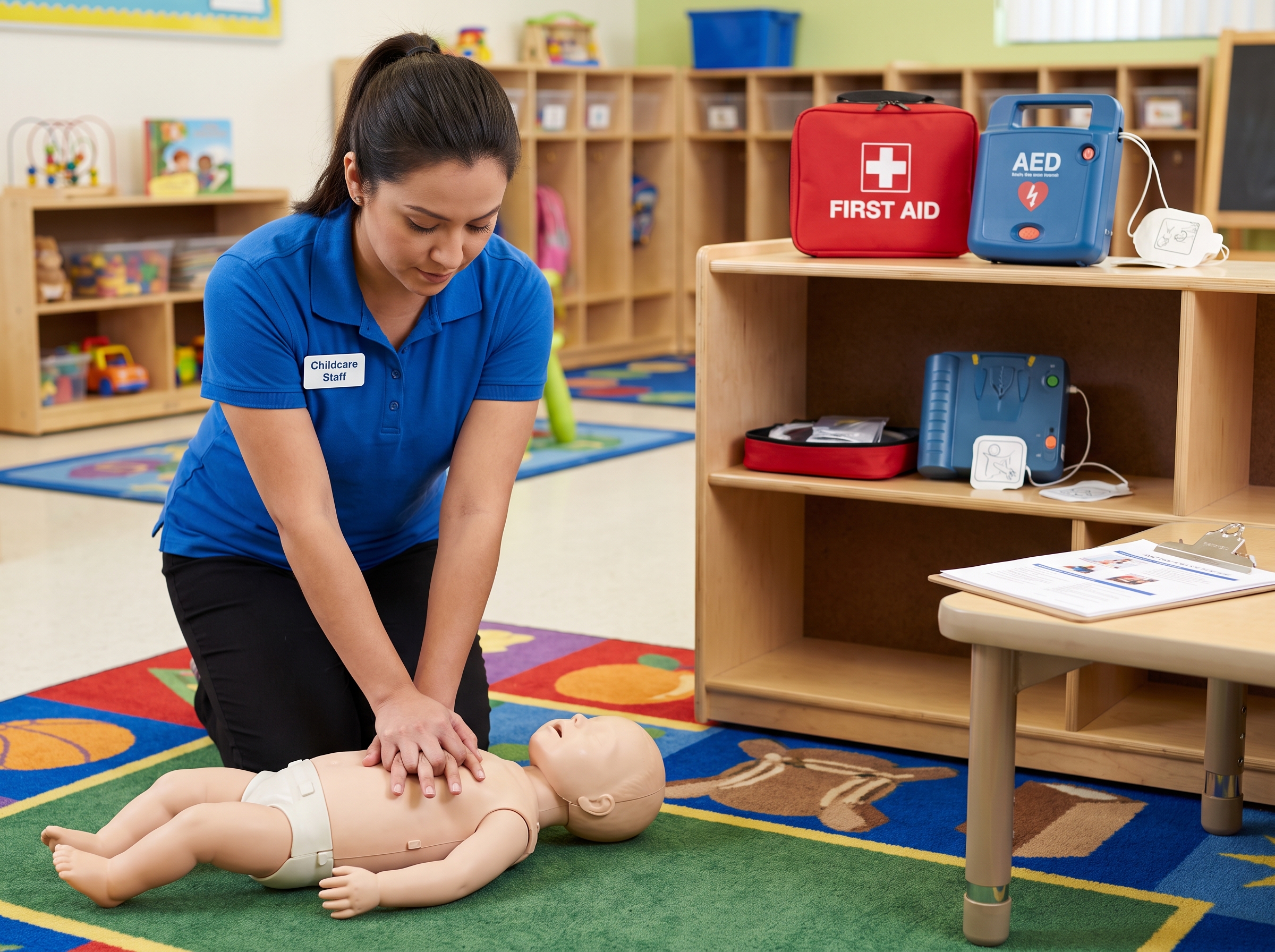
Childcare worker practicing pediatric CPR technique during a training session


If Your Job Is Not on Either List

If your role does not involve direct patient care, supervising children, or responding to medical emergencies as part of your job description, you likely do not need healthcare-provider BLS at all. A standard CPR and AED course - sometimes labeled a lay-rescuer or workplace course - is built for exactly this situation: office employees, retail staff, corporate wellness programs, and anyone who wants to be prepared to help a coworker, family member, or bystander without the multi-rescuer, clinical-team elements that BLS includes. Choosing the wrong tier is a common mistake; it is worth confirming with your employer or licensing board which one they actually require before you enroll, since the two are not interchangeable on a resume or a compliance file.


Why Getting This Right Matters

The stakes behind this question are not abstract. The CDC reports that hundreds of thousands of people experience out-of-hospital cardiac arrest in the United States every year, and the large majority do not survive to reach a hospital. Research published in Circulation: Cardiovascular Quality and Outcomes found a consistent inverse relationship between how long it takes for bystander CPR to begin and the odds a patient survives to hospital discharge - every minute of delay works against the patient. A study on cardiac arrest survival when CPR is initiated by trained first responders reinforces the same point from a different angle: the person closest to the patient in the first moments has an outsized impact on the outcome, regardless of what specialty ambulance or hospital care follows. This is precisely why employers in patient-facing and child-facing roles treat certification requirements seriously rather than as a box-checking exercise, and why a global review of out-of-hospital cardiac arrest survival consistently identifies early, high-quality CPR as one of the few variables rescuers can actually control. None of these findings depend on advanced equipment or a physician being present - they depend on a trained person being close by and ready to act in the first minute, which is exactly the gap BLS certification is designed to close across every role on this list.


How to Confirm What Your Specific Role Requires

Because requirements vary by state, employer, and even department within the same hospital system, treat the job-by-job breakdown above as a strong starting point rather than a legal guarantee. Before enrolling in anything, it helps to ask a few direct questions - a five-minute phone call to HR or your licensing board can save you from paying for the wrong course, or worse, showing up on day one without the credential your specific unit expects.


  • Does your offer letter, job posting, or HR onboarding packet specifically say "BLS" or does it say "CPR/AED" - the two are not interchangeable.
  • Does your state licensing board (nursing, dental, respiratory therapy, etc.) publish a specific continuing-education or certification requirement.
  • Does your specific facility or department have a stricter internal policy than the state minimum - some hospital units require BLS for every employee regardless of patient contact.
  • Does your role ever put you in a position to respond to a code, a choking event, or a cardiac emergency, even occasionally - if so, BLS is almost always the safer choice over a standard CPR course.


Getting BLS Certified Once You Know You Need It

Once you have confirmed that your role calls for BLS, the certification itself does not need to be complicated or expensive. Affordable ACLS BLS certification and recertification courses are built around current AHA-aligned content, are entirely self-paced online, and are designed by practicing emergency medicine physicians who understand how tight healthcare schedules actually are. If this is your first time certifying rather than a renewal, the BLS Certification course walks you through the full curriculum - high-quality CPR for adults, children, and infants, AED use, and choking response - with unlimited retakes on the exam and an instant digital certificate once you pass, so there is no waiting on a card in the mail before your start date. If your facility requires ACLS alongside BLS, or if you are weighing which certification to prioritize first, the same self-paced format is available across both courses, which makes it easier to schedule certification around shift work rather than around a fixed classroom date.


The Bottom Line

Nurses, CNAs, medical assistants, dental staff, and PT/OT professionals should assume BLS is required unless told otherwise. Pharmacists, teachers, coaches, lifeguards, and childcare workers fall into a more employer-specific or state-specific category where the right answer depends on your exact setting and patient or student population. And if your job keeps you out of direct patient care or child supervision entirely, a standard CPR/AED course is probably the better fit. When in doubt, confirm with your employer or licensing board first - then get certified in whichever tier actually matches what your job demands. Getting this one detail right, before your first shift or your next renewal deadline, is a small step that keeps you compliant, keeps your patients or students safer, and keeps you from paying for a certification you never actually needed.


ACLS Blogs

Who Needs BLS Certification? A Job-by-Job Requirements Guide

Type "does a dental hygienist need BLS" or "do teachers need CPR certification" into a search bar and you will find a scattered mess of forum answers, outdated blog posts, and conflicting opinions. That is because the honest answer to who needs BLS certification depends entirely on the job, the employer, and sometimes the state - and most articles only cover one occupation at a time.


This guide consolidates the question into a single reference. We will walk through the roles that are almost always required to hold Basic Life Support certification, the roles where it is strongly recommended but not always mandatory, and the roles where a shorter standard CPR course is actually the more appropriate fit. If you are trying to figure out what your job, your license, or your employer actually expects of you, start here.


Part of the confusion comes from where people look for answers. A job board post might casually mention "CPR certification preferred" while the actual state licensing rule underneath it specifies a full BLS provider card, and a hospital's internal policy can be stricter than either one. Rather than treating every occupation as its own mystery, it helps to sort roles into three practical buckets: jobs where BLS is essentially assumed, jobs where it depends heavily on the specific employer or state, and jobs where a standard CPR course is genuinely the better fit. The rest of this guide walks through each bucket in order.


What BLS Certification Actually Covers

Basic Life Support (BLS) certification is a healthcare-provider-level course built around high-quality CPR for adults, children, and infants, AED use, relief of choking, and team-based resuscitation skills such as coordinating compressions and ventilations with other rescuers. It is designed for people who are expected to respond to a cardiac or respiratory emergency as part of their job duties, often inside a clinical environment where they may be working alongside other trained responders.


That distinction matters because BLS is not the same thing as a general "CPR and First Aid" class aimed at the public. BLS assumes a healthcare context: it covers multi-rescuer resuscitation, high-performance team roles, and scenarios you are more likely to encounter in a hospital, clinic, or emergency response setting. A standard CPR/AED course, by contrast, is built for a single lay rescuer responding to an emergency in public, at work, or at home. Both teach the same core compressions-and-airway skills, but the depth, scenarios, and intended audience differ - which is exactly why so many non-clinical employers ask for "CPR certification" rather than "BLS certification," and why job seekers get conflicting answers when they search for their specific title.


Jobs That Almost Always Require BLS Certification

These are the roles where BLS certification is a standard condition of licensure, employment, or clinical placement. If your job title is on this list, you should assume BLS is required unless your specific employer tells you otherwise.


Nurses and Nursing Students

Registered nurses and licensed practical nurses are the clearest example of a role where BLS certification is essentially universal. Hospitals, skilled nursing facilities, home health agencies, and outpatient clinics require current BLS before a nurse can start patient-facing work, and nursing schools typically require it before students begin clinical rotations. Because nurses are frequently first on the scene of a decompensating patient, employers treat BLS as a non-negotiable baseline rather than a nice-to-have. Nurses working in higher-acuity specialties, such as the emergency department, ICU, or telemetry floor, are often expected to hold ACLS on top of BLS, since those units respond to full cardiac arrest events far more often than a general medical-surgical floor.


If you are specifically weighing whether an entry-level nursing position requires certification before your first day, we have a dedicated breakdown in Is BLS Certification Necessary for Entry-Level Nursing Jobs?, which digs into hiring timelines, new-grad exceptions, and how facilities handle candidates who are certified but still waiting on their license. This article, by comparison, is meant to answer the broader "which jobs need this" question across every role, not just nursing.

Nurse and nursing assistant practicing two-rescuer CPR during BLS training


CNAs and Nursing Assistants

Certified nursing assistants and patient care technicians work in direct, hands-on contact with patients who are often older, medically fragile, or recovering from surgery - exactly the population most likely to experience a cardiac or respiratory event. Most state CNA programs and long-term care facilities require BLS certification as part of onboarding, and many renew it on the same two-year cycle as the nursing staff they support. If your CNA program did not require it up front, expect your first employer to.


Medical Assistants

Medical assistants working in physician offices, urgent care centers, and outpatient specialty clinics are usually required to hold BLS certification, particularly in practices that perform procedures, administer injections, or handle patients under sedation. Even in lower-acuity primary care settings, BLS is commonly listed as a job requirement because medical assistants are frequently the staff member closest to a patient when a reaction or emergency begins. Many medical assisting certificate programs now build a BLS module directly into the curriculum so graduates arrive at their first job already credentialed.


Dental Staff: Dentists, Hygienists, and Dental Assistants

Dental offices administer local anesthesia, sedation, and nitrous oxide, all of which carry a small but real risk of an adverse cardiac or respiratory event chairside. As a result, most state dental boards require dentists, hygienists, and often dental assistants to maintain current BLS certification as a condition of licensure or continued employment, and many offices run mock emergency drills to keep the whole team ready, since a chairside emergency leaves little time to locate equipment or assign roles on the fly. For a closer look at how this plays out across a dental practice, see The Importance of BLS & ACLS for Dental Practices.


Pharmacists and Pharmacy Staff

Pharmacist BLS requirements vary more than most other roles on this list. Retail pharmacists who administer immunizations are frequently required to hold current BLS or an equivalent immunizing-pharmacist certification, since anaphylaxis is a recognized (if rare) risk after vaccination. Clinical and hospital pharmacists, particularly those who round with code teams or work in acute care, are increasingly expected to carry BLS as well, and some pursue ACLS to participate more actively in resuscitation events, including preparing and verifying code-cart medications during an active response. We cover this expanding role in Clinical Pharmacists and ACLS: Expanding Your Role in Code Response Teams.


Physical and Occupational Therapists

PTs and OTs work with patients during physically demanding activity - ambulation, strength training, cardiac rehab - which is precisely when an underlying cardiac issue is most likely to surface. Hospital-based and outpatient rehab employers commonly require BLS certification for both therapists and therapy assistants, and many cardiac and pulmonary rehab programs will not credential a therapist without it, since patients in these programs are, by definition, being monitored for exercise-induced cardiac symptoms. We break down exactly which practice settings require it in The Benefits of BLS and ACLS Certification for Physical Therapy Practice Staff.


Roles Where BLS Is Common but Not Always Mandatory

The next group of roles sits in a gray area. BLS certification is not universally required by law or licensure, but it is increasingly requested by employers, and the underlying skills are directly relevant to the population being served. In these roles, the deciding factor is usually less about the job title itself and more about how much unsupervised responsibility the role carries for someone else's safety.


Teachers and Coaches

Teachers and athletic coaches are rarely required to hold healthcare-provider-level BLS certification, but a growing number of school districts and athletic programs now require or strongly encourage CPR/AED training for staff who supervise students during activities where sudden cardiac events - however rare - carry outsized consequences given the time-sensitive window before EMS arrives. We cover the specifics of this trend in School-Based Cardiac Emergencies: How Teachers and Coaches Can Bridge the Gap Until EMS Arrives. For most educators, a standard CPR/AED course covers what the role actually demands, though some choose full BLS if they also work with medically complex students.


Lifeguards

Lifeguards need a specific combination of skills: water rescue, spinal precautions, and CPR/AED response for drowning and submersion emergencies. Most lifeguard certifying bodies bundle their own CPR/AED module directly into lifeguard training rather than requiring a separate healthcare-provider BLS card, because the scenarios and equipment access differ from a clinical setting. That said, lifeguards who also work part-time in a clinical or camp-nurse capacity sometimes carry full BLS to satisfy both roles at once, and aquatics directors overseeing larger facilities may require it of senior staff regardless of the base lifeguard course.


Childcare Workers

Childcare and daycare requirements are set primarily at the state licensing level, and they vary widely. Many states require at least one certified staff member on-site at all times with current pediatric CPR/first aid training, while some centers - particularly those serving infants or medically fragile children - opt for full BLS across their staff. We walk through how these requirements are typically structured in Daycare Centers: Do All Require PALS / BLS?, which is worth reading if you manage or work at a licensed childcare facility.

Childcare worker practicing pediatric CPR technique during a training session


If Your Job Is Not on Either List

If your role does not involve direct patient care, supervising children, or responding to medical emergencies as part of your job description, you likely do not need healthcare-provider BLS at all. A standard CPR and AED course - sometimes labeled a lay-rescuer or workplace course - is built for exactly this situation: office employees, retail staff, corporate wellness programs, and anyone who wants to be prepared to help a coworker, family member, or bystander without the multi-rescuer, clinical-team elements that BLS includes. Choosing the wrong tier is a common mistake; it is worth confirming with your employer or licensing board which one they actually require before you enroll, since the two are not interchangeable on a resume or a compliance file.


Why Getting This Right Matters

The stakes behind this question are not abstract. The CDC reports that hundreds of thousands of people experience out-of-hospital cardiac arrest in the United States every year, and the large majority do not survive to reach a hospital. Research published in Circulation: Cardiovascular Quality and Outcomes found a consistent inverse relationship between how long it takes for bystander CPR to begin and the odds a patient survives to hospital discharge - every minute of delay works against the patient. A study on cardiac arrest survival when CPR is initiated by trained first responders reinforces the same point from a different angle: the person closest to the patient in the first moments has an outsized impact on the outcome, regardless of what specialty ambulance or hospital care follows. This is precisely why employers in patient-facing and child-facing roles treat certification requirements seriously rather than as a box-checking exercise, and why a global review of out-of-hospital cardiac arrest survival consistently identifies early, high-quality CPR as one of the few variables rescuers can actually control. None of these findings depend on advanced equipment or a physician being present - they depend on a trained person being close by and ready to act in the first minute, which is exactly the gap BLS certification is designed to close across every role on this list.


How to Confirm What Your Specific Role Requires

Because requirements vary by state, employer, and even department within the same hospital system, treat the job-by-job breakdown above as a strong starting point rather than a legal guarantee. Before enrolling in anything, it helps to ask a few direct questions - a five-minute phone call to HR or your licensing board can save you from paying for the wrong course, or worse, showing up on day one without the credential your specific unit expects.


  • Does your offer letter, job posting, or HR onboarding packet specifically say "BLS" or does it say "CPR/AED" - the two are not interchangeable.
  • Does your state licensing board (nursing, dental, respiratory therapy, etc.) publish a specific continuing-education or certification requirement.
  • Does your specific facility or department have a stricter internal policy than the state minimum - some hospital units require BLS for every employee regardless of patient contact.
  • Does your role ever put you in a position to respond to a code, a choking event, or a cardiac emergency, even occasionally - if so, BLS is almost always the safer choice over a standard CPR course.


Getting BLS Certified Once You Know You Need It

Once you have confirmed that your role calls for BLS, the certification itself does not need to be complicated or expensive. Affordable ACLS BLS certification and recertification courses are built around current AHA-aligned content, are entirely self-paced online, and are designed by practicing emergency medicine physicians who understand how tight healthcare schedules actually are. If this is your first time certifying rather than a renewal, the BLS Certification course walks you through the full curriculum - high-quality CPR for adults, children, and infants, AED use, and choking response - with unlimited retakes on the exam and an instant digital certificate once you pass, so there is no waiting on a card in the mail before your start date. If your facility requires ACLS alongside BLS, or if you are weighing which certification to prioritize first, the same self-paced format is available across both courses, which makes it easier to schedule certification around shift work rather than around a fixed classroom date.


The Bottom Line

Nurses, CNAs, medical assistants, dental staff, and PT/OT professionals should assume BLS is required unless told otherwise. Pharmacists, teachers, coaches, lifeguards, and childcare workers fall into a more employer-specific or state-specific category where the right answer depends on your exact setting and patient or student population. And if your job keeps you out of direct patient care or child supervision entirely, a standard CPR/AED course is probably the better fit. When in doubt, confirm with your employer or licensing board first - then get certified in whichever tier actually matches what your job demands. Getting this one detail right, before your first shift or your next renewal deadline, is a small step that keeps you compliant, keeps your patients or students safer, and keeps you from paying for a certification you never actually needed.


blogs

More articles for you

all articles

Start Today!

Get certified at your own pace, on your schedule, from the comfort of your home.