If you run an ambulatory surgery center, you have probably heard three different answers to the same question. A surveyor says "staff must be trained in resuscitation." A vendor says "everyone needs ACLS." A veteran charge nurse says "just BLS is fine for most of the team." Each of those statements can be partly true, and that is exactly why surgery center ACLS requirements are so easy to get wrong.
The confusion comes from the layers. Federal rules set a floor. Your state licensing agency may add to it. Your accrediting organization layers its own expectations on top. Your medical staff bylaws and anesthesia policies then decide who actually holds which card. This guide walks through those layers in plain language, shows how the roles on a typical ASC team usually map to BLS, ACLS, and PALS, and gives you a practical way to document it all before a survey.
One note up front: this article is a planning aid, not a copy of any standards manual. Accreditation manuals are revised, and the exact wording matters. Always confirm against the current edition your organization is surveyed under. We will point you to the primary sources as we go.
If you want the clinical side of the story, including what rare cardiac events look like inside a surgery center, we cover that separately in ACLS Essentials for Ambulatory Surgery Center Staff. Here, we stay on the compliance and staffing question your survey readiness depends on.
Think of your obligations as a stack. You need to satisfy every layer, and the strictest one usually wins.
For Medicare-certified ASCs, the environment condition lives in 42 CFR 416.44 on the eCFR. In the emergency-related portion, the regulation requires that the ASC medical staff and governing body specify the types of emergency equipment needed for the operating room, and that this equipment be immediately available. It also requires that personnel trained in the use of emergency equipment and in cardiopulmonary resuscitation be available whenever there is a patient in the ASC.
Read that language carefully, because administrators often over- or under-read it. The federal text speaks of training in cardiopulmonary resuscitation and in the use of your emergency equipment. It does not, in the passage above, name ACLS or any particular course by brand. That means the federal floor is about having trained people present whenever a patient is in the building, and about your own policies defining the equipment. It leaves the specifics of who holds which credential to you, your state, and your accreditor.
The practical takeaway: "available whenever there is a patient in the ASC" is a coverage requirement, not just a headcount requirement. If your recovery area stays open after the last case or a patient waits for a ride, someone with current resuscitation training must still be on site. Build that into your scheduling, not just your training spreadsheet.
State rules vary widely. Some states publish detailed licensing regulations for ambulatory surgical facilities that address staffing, emergency equipment, and sometimes specific life-support credentials. Others leave more to accreditors and facility policy. We will not generalize here, because the honest answer is "it depends on your state." Check your state health department or licensing agency for the current regulation that applies to your facility type, and ask your accreditor whether any state-specific items are folded into the survey.
Most ASCs are surveyed by an accrediting organization rather than directly by the state. The three names administrators hear most often are AAAHC, The Joint Commission, and Quad A (AAAASF). Each publishes its own standards, and each updates them on its own schedule.
AAAHC describes its ambulatory accreditation program on its website, and the full requirements sit in its Accreditation Handbook for Ambulatory Health Care, which you obtain from the organization. The Joint Commission's ambulatory care accreditation preparation page points to its ambulatory standards, which address areas such as resuscitation services, staff education, and staffing plans. Quad A publishes its own standards for surgical facilities.
We are deliberately not quoting chapter numbers or standard wording here. Those details change between editions, and a paraphrase from a blog post is a poor substitute for the manual on your desk. What we can say with confidence is the pattern surveyors look for across all of them: defined emergency equipment, staff trained to use it, a documented plan for who responds, and evidence that training is current.
This is the layer that most often decides whether a nurse needs ACLS. Your anesthesia group may require that every anesthesia provider hold advanced life support credentials. Your medical staff bylaws may make a current card a condition of privileges. Your policies may require that at least one ACLS-trained clinician be present during all patient hours. These are choices you make, and a surveyor will expect you to follow them exactly as written.
A policy you wrote but do not follow is worse than no policy at all. Write what you can actually staff and verify.

Because the federal and accreditor language is role-neutral, the role-by-role mapping is mostly a policy decision. The list below reflects common practice and the logic behind it. Treat it as a starting draft for your medical director and nursing leadership, not as a regulatory mandate.
If you want the underlying differences between the courses before you decide, our explainer on which certification you actually need covers them clearly.
Anesthesia providers manage airway, ventilation, and hemodynamics, so advanced life support is the usual expectation. The American Society of Anesthesiologists' Statement on Office-Based Anesthesia says that personnel trained in advanced resuscitative techniques (it lists PeRLS, ACLS, and PALS as examples) should be immediately available until all patients are discharged home, and that an emergency cart with a defibrillator and emergency drugs should be available. That statement addresses office-based settings, but many ASC medical directors borrow the same logic.
There is also an ongoing conversation in anesthesia about how standard ACLS maps onto the operating room. The Anesthesia Patient Safety Foundation has published commentary on reevaluating ACLS for cardiac arrest in the operating room. If your anesthesia group requires a perioperative-specific credential in addition to or instead of ACLS, follow that requirement and document it.
Requirements for surgeons vary by medical staff bylaws. Some centers require current BLS for all privileged physicians. Others require ACLS, particularly where the surgeon directs the case without a dedicated anesthesia provider, or where moderate sedation is administered under the proceduralist's supervision. Your credentialing committee decides, and this is one of the most common places surveyors ask to see the written rule.
Nurses are where the answer splits. Many centers require BLS for every clinical nurse and ACLS for PACU nurses, circulating nurses who function as the code responder, or anyone who monitors patients under sedation. Others require ACLS for all RNs. The logic usually follows who will be at the bedside first and who will run or support the response. For a role-by-role breakdown of nursing in particular, see Do RNs Need ACLS? Which Nursing Roles Actually Require It.
If your center sees pediatric patients, add PALS to the conversation. A common approach is to require PALS for at least the pediatric-trained nurses and the anesthesia providers who care for children, and to make sure a PALS-trained clinician is present whenever children are in the building. Your accreditor and your case mix drive this one.
Surgical technologists and other clinical support staff who may be in the room during an emergency are commonly required to hold BLS. This keeps chest compressions, AED use, and airway support within reach of everyone in the clinical area, so the response does not depend on one or two people. For a job-by-job view of who typically needs BLS, our guide Who Needs BLS Certification? is a useful companion.
Non-clinical staff are the most debated group. The federal condition ties the requirement to personnel who must be available whenever a patient is in the ASC, which does not automatically sweep in everyone on the payroll. Still, some centers choose BLS for front-desk staff so that someone can start compressions and call for help in a waiting room or parking area. Whatever you decide, write it down and apply it consistently.
A wall of current certificates does not meet a requirement that trained personnel be available whenever a patient is in the building. Coverage is a scheduling problem, and surveyors can test it by asking who was present at a specific time. Build a simple coverage check into your staffing process.
You do not need elaborate paperwork, but you do need paperwork that is consistent and easy to retrieve. At a minimum, plan to produce the following on request:
Tracking is where most centers slip, not training. A card that expired last month is just as much a finding as a card that was never earned. If you do not yet have a reliable system, our guide to tracking staff certification expirations lays out a simple approach.
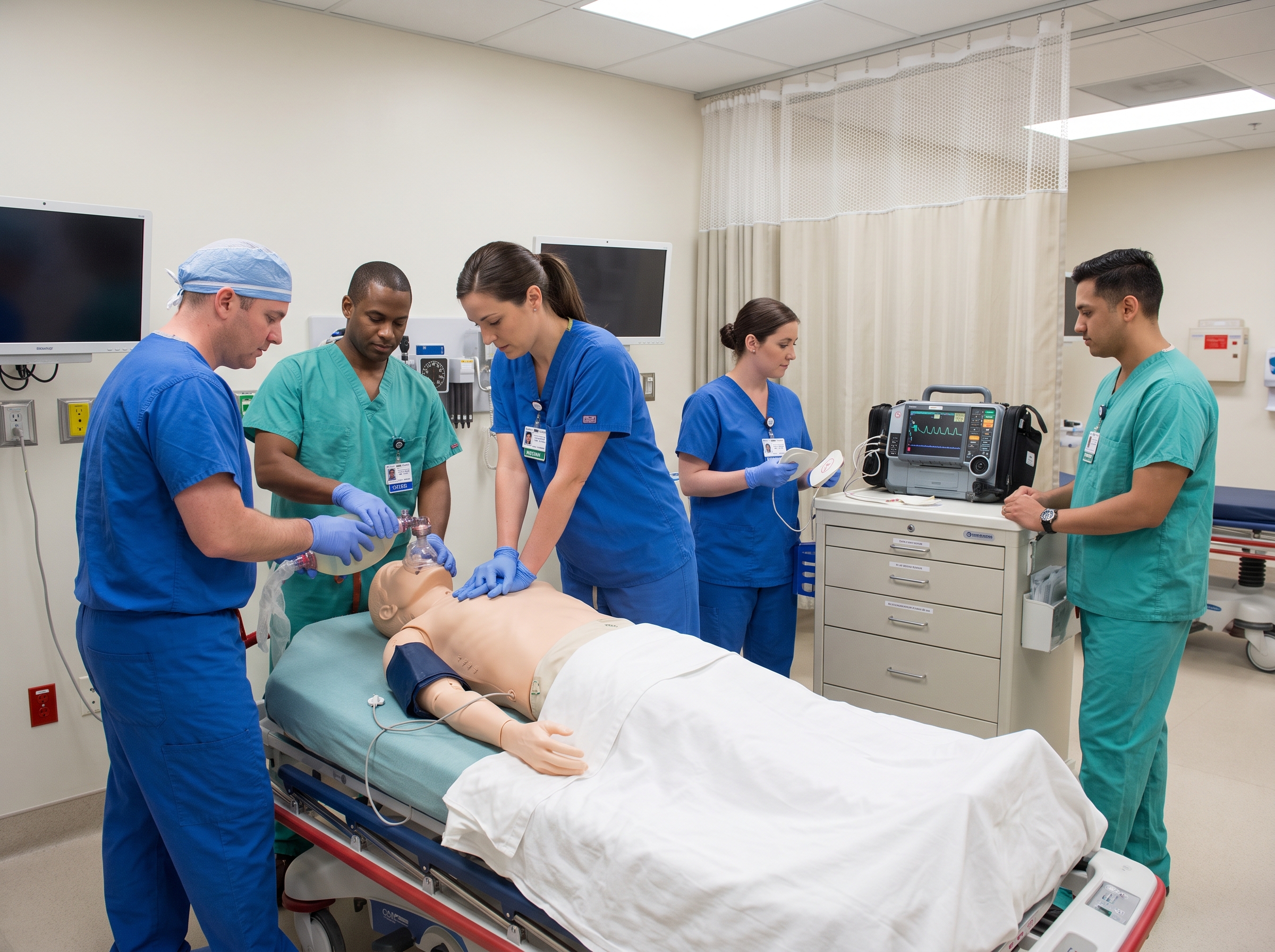
Mock codes also deserve a place in your plan. Accreditors look for staff who can apply training under pressure, not just hold a card. Practicing as a team, then debriefing, shows you are building real readiness rather than collecting paper.
Once your role map is set, the next question is logistics. Pulling a full surgical team off the schedule for in-person classes costs you cases, and cases are your revenue. That is why many ASC administrators look at online options for staff who need ACLS, BLS, or PALS, particularly for renewals.
Online courses from Affordable ACLS are self-paced, can be completed on a phone, tablet, or computer, and are built on current AHA and ILCOR guidelines. Staff can download a digital certificate on completion, retake exams at no extra charge until they pass, and the company backs its courses with a money-back guarantee if an employer does not accept the certification. Before you standardize on any provider, though, do two things: confirm that your accrediting organization and your medical staff are comfortable with the format, and put the acceptance rule in writing in your policy.
For teams, the administrative side matters as much as the course itself. Enrolling staff one at a time through personal accounts creates reimbursement headaches and scattered records. The Group Purchase Catalog is built for managers and administrators who want to certify a team together. If your priority is advanced life support for a block of nurses and providers, take a look at ACLS Certification for Groups, which is designed for facility-level enrollment.
You can get survey-ready without a massive project. Work through these steps in order.
Surgery center life-support requirements are a stack of layers: federal conditions, state rules, accreditor standards, and your own policies. The federal text focuses on trained personnel being available whenever a patient is present, and on defined emergency equipment. Who specifically holds ACLS, BLS, or PALS is largely set by your accreditor, your state, and your medical staff, which is why a written role map and a reliable tracking system matter so much.
Start with the primary sources, confirm the current edition of your standards, and document your decisions. When it is time to get the team certified, group enrollment keeps the process organized and keeps your people on the schedule instead of in a classroom. For managers weighing this across several departments, The Department Manager's Guide to Group ACLS Certification is a good next read.
.jpg)