If you work with babies and children, you have probably heard both acronyms thrown around the unit: "Are you PALS or NRP?" The question sounds simple, but the answer depends on who your patients are, where you work, and what your employer's policy says. Mixing them up can mean a delayed start date, a scramble to book a course, or a credential that does not match the patients you actually resuscitate.
This guide breaks down PALS vs NRP in plain terms: what each program covers, who typically needs which one (or both), how the two differ in format and renewal, and how to decide what to get first. We practice emergency medicine ourselves, so we will stay practical and keep the clinical details tied to what you will actually be tested on and expected to do at the bedside.
One note up front: Affordable ACLS offers online PALS, ACLS, and BLS. We do not offer NRP, and we will not pretend otherwise. What we can do is explain the difference honestly so you pick the right credential and ask your employer the right questions.
NRP (Neonatal Resuscitation Program) is about the transition from womb to world. It trains you to support a newborn in the first minutes after birth: drying, warming, stimulating, opening the airway, giving positive pressure ventilation, and escalating to compressions, intubation, and medications when needed. PALS (Pediatric Advanced Life Support) is about recognizing and treating critically ill or injured infants and children, from respiratory failure and shock to arrhythmias and cardiac arrest. Newborn at delivery equals NRP territory. Sick infant or child beyond the delivery room equals PALS territory.
NRP is an evidence-based education program built around neonatal resuscitation science, and it is developed in collaboration between the American Academy of Pediatrics and the American Heart Association. The program is anchored to the neonatal guidelines published in Circulation, including the 2020 AHA neonatal resuscitation guidelines, which stress that inflation and ventilation of the lungs are the priority in newly born infants who need support after birth.
In practice, NRP training focuses on a defined sequence at delivery:
The 2020 guideline summary notes that a rise in heart rate is the most important sign of effective ventilation and response to resuscitation, and that compressions are added when the heart rate remains below 60 per minute despite 30 seconds of adequate ventilation. If you want a refresher on the flow of that sequence, our walkthrough of the neonatal resuscitation algorithm in the delivery room covers it step by step.
Newborns are physiologically different from older infants. Most newly born babies who need help have a primary breathing problem, not a primary heart problem, which is why NRP is so airway- and ventilation-centered. For a broader look at why this training matters on labor and delivery units, see our article on the importance of being Neonatal Resuscitation Program certified.
PALS is the AHA's advanced life support course for infants and children. The AHA's pediatric chapters are cochaired with the American Academy of Pediatrics, and the 2025 update, Part 8: Pediatric Advanced Life Support, is the current reference for advanced pediatric care. Where NRP centers on the first minutes of life, PALS is built around a systematic approach to a deteriorating child.
A typical PALS course covers:
A theme running through the pediatric guidelines is that cardiac arrest in infants and children usually does not start as a primary cardiac event. It is more often the end result of progressive respiratory failure or shock. That is why PALS puts so much weight on early recognition and treatment of the failing child, before the heart stops. You can see this reflected in the AHA's pediatric basic and advanced life support guideline, and in our own articles on the PALS primary and secondary surveys and the pediatric cardiac arrest algorithm.
If you decide PALS is the right fit, you can complete it online at your own pace through our PALS certification and recertification course. The course is built on AHA and ILCOR guidelines, includes unlimited retakes, and is backed by a money-back guarantee if your employer does not accept the certification.
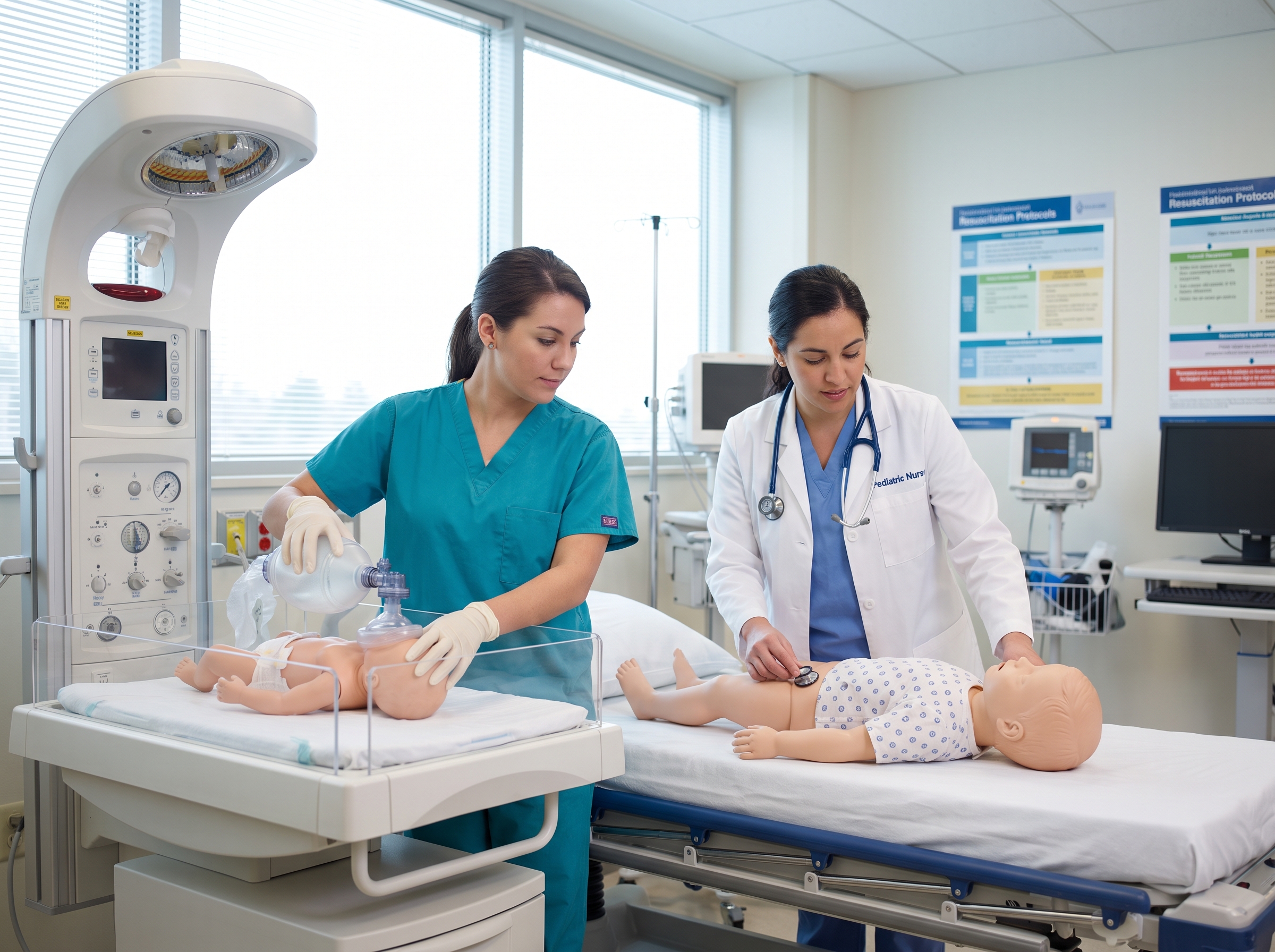
Here is the comparison that most clinicians are really looking for. Treat it as a framework, then verify details with your employer, since facility policies vary.
NRP: newly born infants, in the delivery room or immediately after birth, including the stabilization period right after transition. PALS: infants and children who are seriously ill or injured and at risk of arrest, or already in arrest, outside the immediate newborn transition. Many hospitals use the NICU, nursery, and delivery room as the NRP world and the pediatric ED, PICU, and floors as the PALS world.
NRP is a single, tightly sequenced algorithm driven by heart rate, oxygenation, and ventilation response. PALS is a set of algorithms plus a systematic assessment approach that lets you work through respiratory, shock, and rhythm problems. NRP rewards precision and speed on a short, predictable pathway. PALS rewards pattern recognition across many possible presentations.
NRP is delivered through the AAP's program, and in the standard model it pairs online learning with a hands-on skills and simulation component. PALS is offered in several formats depending on the provider, from classroom to blended to fully online. Because employers differ on what format they accept, always confirm before you enroll. Our PALS course is 100% online and self-paced, and our money-back guarantee covers situations where an employer will not accept it.
Both credentials are time-limited and require renewal, and the cycle is usually about two years for each. Do not assume your renewal dates line up. Many clinicians hold both and end up tracking two separate expiration dates. Our PALS renewal guide explains the timeline and what to do if yours is close to lapsing.
Requirements come from your employer, your unit, and sometimes your state or credentialing body, not from the certification itself. With that caveat, here is how these programs usually map to roles.
NICU staff are most commonly required to hold NRP, because they attend high-risk deliveries and care for the most fragile newborns. Many NICUs also ask for PALS, particularly for nurses who care for infants who are older or who transfer between the NICU and pediatric units. If the unit takes babies who have been home and returned, or follows patients into early infancy, PALS knowledge becomes relevant.
Labor and delivery nurses frequently need NRP because they are present for the first minutes of life. Mother-baby and newborn nursery staff often need NRP as well, since they monitor babies during transition and may be first to respond to a baby who is struggling. Adult life support, usually ACLS and BLS, is also typically required for the maternal side of the unit. Whether PALS is required on L&D varies widely, and in many facilities it is not.
Pediatric emergency, pediatric intensive care, and pediatric floor staff are the classic PALS audience. These clinicians manage infants and children with respiratory failure, shock, sepsis, and arrhythmias. NRP is usually not a requirement here unless the unit routinely receives newly born infants, such as an ED that supports unexpected deliveries.
Neonatologists, pediatric hospitalists, pediatric emergency physicians, and anesthesiologists who cover deliveries or cesarean sections may need NRP, PALS, or both. Respiratory therapists who attend deliveries or work in NICU and pediatric units often hold both, because airway and ventilation expertise is central to both programs. Emergency physicians and advanced practice providers in general EDs often hold PALS so they can lead a pediatric resuscitation when a critically ill child arrives.
EMS agencies commonly require PALS or an equivalent pediatric module. Neonatal and pediatric transport teams usually need both, since a single transport can involve a newborn on one call and an infant with sepsis on the next.
Many roles sit at the border. A NICU nurse who also floats to the pediatric unit, a pediatric ED nurse at a hospital with a delivery service, a transport nurse, or an anesthesiologist covering OB and peds could all hold both credentials. If you are unsure, ask your manager or educator whether the requirement is NRP, PALS, or both, and whether it is a condition of hire or a unit-level expectation.
Use this as a conversation starter with your employer, not as a final answer.
Knowing the clinical differences helps you see why one credential cannot stand in for the other.
For newborns who need compressions, the neonatal guidance describes the two thumb-encircling hands technique with a 3 to 1 compression-to-ventilation ratio. In pediatric resuscitation, the ratio and approach depend on the number of rescuers and whether an advanced airway is in place. The 2025 pediatric basic life support update also addresses infant compression technique, and the 2025 AHA guidelines executive summary is the place to see how the sections fit together. Your instructor or course will walk you through the pediatric ratios in detail.
In newborns, the problem is usually the lungs failing to expand and oxygenate. In older infants and children, the problem is usually progressive respiratory failure or shock. In both groups the heart is typically healthy until it is starved of oxygen, which is why early airway and ventilation skills matter in both programs. That shared foundation is also why BLS is a prerequisite or baseline for so many roles, and why so many learners start there. Our guide on which of ACLS, PALS, and BLS you actually need can help you sort the broader picture.
Both programs teach epinephrine, but access routes, dosing, and the situations where medications are even considered differ. In newborns, umbilical venous access is a key skill. In older infants and children, intraosseous access and weight-based dosing take center stage. Our PALS weight-based dosing quick reference is a useful companion once you are in PALS territory.
If you are staring at a job posting, a unit transfer, or an annual competency list, work through these steps.
If your unit also treats adults or you are building toward a broader role, you may also wonder about ACLS. Our comparison of ACLS vs PALS and which to get first is a helpful read for that decision.
If your role calls for PALS, you do not need to give up a weekend. Our course is fully online, self-paced with no time limits, and can be completed from a phone, tablet, or computer. You can save your progress, retake the exam as many times as you need at no extra charge, and download your certificate when you finish. If this is your first PALS, start with the PALS certification course. If you are renewing, the PALS recertification option on the PALS page is the right place.
For NRP, go through the AAP's program as your employer directs. We are not an NRP provider, and we would rather you get the correct credential than the convenient wrong one. Whatever your mix of cards, the goal is the same: when a baby or child needs you, you recognize the problem fast and know your next step.
No. NRP focuses on resuscitating newly born infants at and just after delivery. PALS focuses on recognizing and treating critically ill or injured infants and children, including pediatric cardiac arrest.
Usually not. Most NICUs specify NRP because of the delivery room role, though many also want PALS. Confirm the exact requirement with the hiring manager or unit educator.
It depends on the facility. NRP is the more common requirement on labor and delivery, but some hospitals add PALS or ask for it for specific roles. Check your unit policy.
Get the one your role or employer requires first. If you are moving into a unit that needs both, ask which deadline comes first, and keep your BLS current in the meantime.
No. We offer online ACLS, BLS, and PALS. NRP is a separate program that you complete through the channels your employer recognizes.
The PALS vs NRP question comes down to your patient. If you resuscitate newborns in the first minutes of life, NRP is your core credential. If you care for sick infants and children, PALS is. Many clinicians in NICU, transport, and mixed pediatric-obstetric settings need both. Confirm with your employer, put your renewal dates on one calendar, and keep your BLS current. When PALS is on your list, our PALS recertification course and first-time certification are online, self-paced, and built on current AHA and ILCOR guidelines, so you can get certified without rearranging your schedule.
.jpg)