ACLS Blogs

Synchronized Cardioversion Quick Reference: Energy Settings by Rhythm

The Number You Need Before You Press the Button

You are standing at the bedside of a patient with a heart rate of 170, a falling blood pressure, and a monitor that looks like it is arguing with itself. The pads are on. The defibrillator is powered up. Someone asks the question every ACLS provider dreads in the moment and loves on the exam: "What energy do you want?"


This quick reference is built for exactly that second. It gives you a scannable table of synchronized cardioversion energy by rhythm, the one rhythm where you should not use sync at all, the device-specific caveat that now sits at the top of the AHA tachyarrhythmia algorithm, and the sync-button pitfall that catches experienced clinicians. If you want the full conceptual walkthrough of how cardioversion works, our earlier piece, Becoming Familiar with Synchronized Cardioversion: A Comprehensive Guide, covers the mechanics. This article is the one-page card you keep open next to the megacode station.


First, Is This Patient Actually a Cardioversion Candidate?

Energy selection only matters after you have decided that electricity is the right treatment. In the adult tachycardia with a pulse pathway, the deciding question is whether the patient is unstable because of the tachyarrhythmia. The classic signs of instability are hypotension, acutely altered mental status, signs of shock, ischemic chest discomfort, and acute heart failure. A fast heart rate alone is not instability.


If the patient is persistently tachyarrhythmic and unstable, the algorithm calls for immediate synchronized cardioversion. If the patient is stable, you have time to get a 12-lead, consider vagal maneuvers or adenosine for a regular narrow-complex rhythm, and involve expert consultation for anything wide or irregular. Our ACLS tachycardia algorithm companion on stable versus unstable decisions walks through that fork in detail, and the SVT treatment decision card covers the stable narrow-complex branch.


One more gate before the table: confirm a pulse. Synchronized cardioversion is for tachyarrhythmias with a pulse. If there is no pulse, you are in the cardiac arrest algorithm, and the shock is an unsynchronized defibrillation. Mixing those two pathways up is one of the most common ways to lose points on a megacode.


Synchronized Cardioversion Energy by Rhythm

The table below uses the initial doses printed on the long-standing AHA adult tachycardia with a pulse algorithm, which is the version most course materials, protocols, and exam answer keys are built around. You can verify every value on the AHA adult tachycardia with a pulse algorithm. Read the device caveat in the next section before you treat these numbers as fixed, because the newest AHA algorithm changed how first-shock energy is framed.


RhythmTypical examplesSync?Initial energy on the AHA algorithm Narrow regularSVT, atrial flutter with fixed conductionYes50-100 J Narrow irregularAtrial fibrillation, flutter with variable blockYes120-200 J biphasic, or 200 J monophasic Wide regularMonomorphic ventricular tachycardia with a pulseYes100 J Wide irregularPolymorphic VT, pre-excited atrial fibrillationNoDefibrillation dose (unsynchronized)

If the first shock does not convert the rhythm, the algorithm says to increase the dose in a stepwise fashion. That is the rule to remember: start at the listed energy, then climb. You do not sit at 50 J for three attempts.


Narrow Regular: Start Low, Expect Success

Regular narrow-complex tachycardias, such as AV nodal reentrant SVT and typical flutter, are highly electrosensitive. That is why the starting energy is the lowest on the card. In a stable patient you would usually try vagal maneuvers and adenosine first, as covered in our guide to vagal maneuvers before adenosine. In an unstable patient, add sedation if time allows and deliver a synchronized shock.


Narrow Irregular: Atrial Fibrillation Needs More Energy

Atrial fibrillation is the rhythm where low-energy habits cost you shocks. The AHA algorithm lists a higher range for it (120-200 J biphasic, 200 J monophasic), and the 2025 AHA adult advanced life support guideline emphasizes that higher first-shock energy settings, 200 J or more with a biphasic device, are preferable to lower settings for cardioversion of atrial fibrillation and flutter. You can read the full recommendation in Part 9: Adult Advanced Life Support of the 2025 AHA guidelines. Practically, that means if your protocol or device label gives you a choice for AF, start toward the high end of the range rather than the bottom.


Remember that a patient in atrial fibrillation who is truly unstable from the rhythm is less common than one who is unstable from something else, such as sepsis, hemorrhage, or hypoxia. Always ask whether the tachycardia is the cause or the response. Our overview of narrow complex irregular tachycardia helps with that distinction.


Wide Regular: Treat It as VT Until Proven Otherwise

A regular wide-complex tachycardia in an unstable patient is treated as monomorphic ventricular tachycardia. The listed starting energy is 100 J, synchronized, with stepwise increases if it fails. In a stable patient, the algorithm allows time for a 12-lead ECG, expert consultation, and antiarrhythmic therapy. If you are asked about amiodarone dosing in that setting, our amiodarone dosing quick reference separates the cardiac arrest dose from the stable VT dose, which is a classic exam trap.


Wide Irregular: Do Not Use Sync

This is the row that deserves a red border on your card. A wide, irregular, chaotic rhythm, such as polymorphic VT or pre-excited atrial fibrillation, may have no reliable R wave for the defibrillator to lock onto. If the device cannot find a consistent sync marker, it may delay the shock or refuse to fire while the patient deteriorates. The algorithm directs you to deliver a defibrillation dose, unsynchronized, rather than waiting on sync. Unstable polymorphic VT is handled much like VF in practice: shock now, do not wait.

Clinicians preparing synchronized cardioversion on a defibrillator


The Device Caveat: Check Your Defibrillator First

Here is the change many providers have not caught. The newer AHA adult tachyarrhythmia with a pulse algorithm directs clinicians to refer to the specific device's recommended energy level to maximize first-shock success, and to use the maximum energy setting if the recommended level is not known. In other words, the fixed ranges in the table above are an anchor for exams and general teaching, but the manufacturer's labeled settings for your defibrillator take priority at the bedside.


Why does this matter? Biphasic waveforms are not interchangeable. Different manufacturers use different waveform shapes, and the energy that is optimal for one device is not necessarily the same for another. Monophasic devices, which are increasingly rare, deliver a different waveform again. That is the reason the AHA ranges for biphasic devices span a window rather than a single number.


A Practical Device Checklist

  • Know your unit's model before the code, not during it. Biphasic or monophasic? Check the label or quick-start card on the cart.
  • Find the manufacturer's recommended cardioversion energies for your rhythm categories and put them on the crash cart or in your unit protocol.
  • If you do not know the recommended setting, the current AHA algorithm says to use the maximum energy setting.
  • Confirm that your device is in manual mode, since AED mode does not perform synchronized cardioversion.
  • Follow your facility protocol if it differs from the AHA card, and ask your medical director to resolve differences in advance.


For certification exams, expect the classic ranges to remain the safest answers unless the question explicitly says to follow the device manufacturer. If a question mentions a specific device recommendation, follow it. For a deeper comparison of manual and automated modes and energy settings during arrest, see our article on manual versus automated defibrillation.


The Sync Button Pitfall: It Resets After Every Shock

On many manual defibrillators, the sync function turns itself off after each shock is delivered. This is by design, because if the rhythm degrades into VF after a synchronized shock, you want the next shock to fire immediately as a defibrillation rather than hunt for an R wave that is not there. But it creates a trap: you deliver the first synchronized shock, the patient remains in tachycardia, you increase the energy, and you charge and fire... without re-engaging sync. Check how your own device behaves, because not every model works the same way.


An unsynchronized shock delivered during the vulnerable period of the cardiac cycle can induce ventricular fibrillation in a patient who was previously perfusing. That is the harm the sync function exists to prevent. The fix is a habit, not a gadget.


A Five-Step Routine for Every Cardioversion Attempt

  • Press SYNC. Do this before you set the energy, every attempt.
  • Look for the markers. Confirm the sync marks sit on the R waves, not on T waves or artifact. Adjust lead or gain if they do not.
  • Select the energy. Use the device-recommended or algorithm dose, stepping up if this is a repeat attempt.
  • Charge and clear. Announce it, check that everyone is clear, and hold the shock button until the discharge occurs, since sync may produce a short delay.
  • Reassess and re-sync. If the rhythm persists, press SYNC again before the next attempt.


Say it out loud as the team leader: "Sync on, markers on R waves, charging to ___ joules." Closed-loop communication catches the missed sync button more reliably than silent confidence.
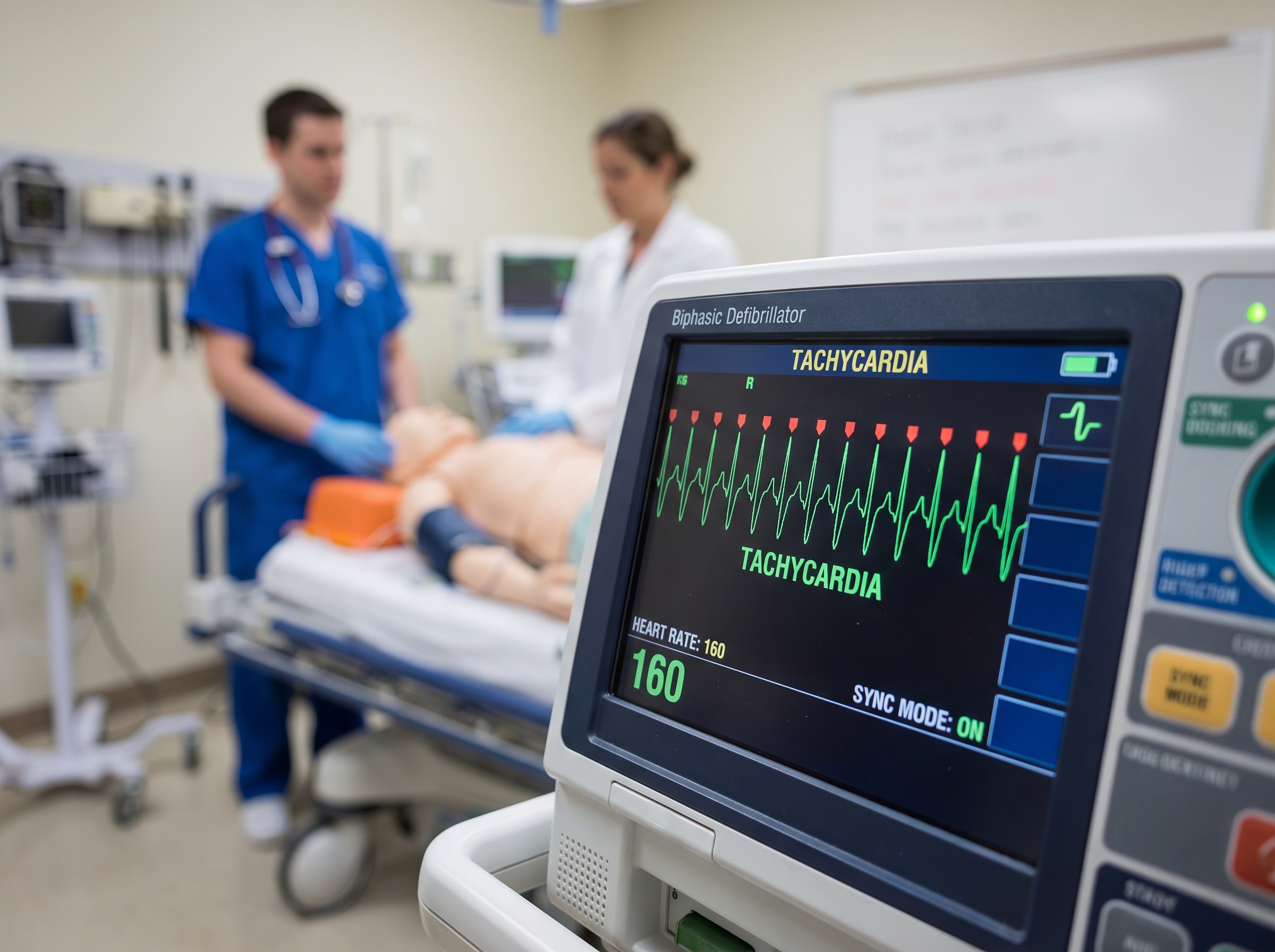
Defibrillator screen showing sync markers on R waves


Sedation, Timing, and the Pre-Shock Pause

The algorithm says to consider sedation in a patient who is awake and has a pulse, because synchronized cardioversion is painful. Sedation should not delay a shock in a patient who is in extremis, but when you have even a short window, a brief pause for analgesia or sedation is part of good care. Our guide to conscious sedation for cardioversion covers agent selection, monitoring, and airway readiness, which matter because the patient is already hemodynamically fragile.


Have suction, a bag-valve-mask, and airway equipment at the bedside before you sedate. Pads should be placed in the position your device instructions describe, away from implanted devices, and the skin should be dry. A good setup prevents the avoidable complications that turn a routine cardioversion into a second emergency.


Common Mistakes Cheat List

  • Using sync on a pulseless patient. No pulse means unsynchronized defibrillation.
  • Trying to sync polymorphic VT. The device may fail to find a marker. Defibrillate.
  • Starting AF at the bottom of the range. Higher first shocks are favored.
  • Forgetting to re-press SYNC after a shock. Many devices reset it.
  • Cardioverting stable patients as the first move. Stable patients get time for a 12-lead and expert input.
  • Ignoring the device label. The current AHA algorithm points you to the manufacturer's recommendation.


How This Shows Up on the ACLS Exam and Megacode

On written exams, the tachycardia questions typically reward three skills: classifying the rhythm as narrow or wide and regular or irregular, deciding between stable and unstable pathways, and choosing the first intervention. A megacode adds execution. Your instructor wants to see you ask for sedation if appropriate, press sync, verify markers, state the energy, clear the team, and then reassess. If the first shock fails, show the stepwise increase out loud.


The fastest way to lock this in is repetition. Run the four rhythm categories until the energy pairing is automatic, then test yourself with scenario questions in our free ACLS practice tests, and review the logic of each branch on the ACLS algorithms hub. If you are due to certify or renew, the self-paced online ACLS course covers cardioversion alongside every other algorithm, and it comes with unlimited retakes and a money-back guarantee if your employer does not accept the certification.


A Memory Aid for the Four Rows

Try the idea of "regular is lower, irregular is higher, wide irregular is a shock without sync." Narrow regular rhythms respond to the least energy. Irregular atrial rhythms need more. Wide regular VT sits at a middle starting point. Wide irregular chaos leaves the sync function out entirely. Then add the device rule: check the label, and if you do not know it, go to the maximum.


Quick Takeaways

  • Synchronized cardioversion is for unstable tachyarrhythmias with a pulse.
  • AHA algorithm starting doses: narrow regular 50-100 J, narrow irregular 120-200 J biphasic or 200 J monophasic, wide regular 100 J.
  • Wide irregular or polymorphic rhythms get a defibrillation dose, not sync.
  • The newer AHA algorithm points you to your device's recommended energy, or the maximum setting if unknown.
  • If the first shock fails, increase energy stepwise.
  • Re-press SYNC before every attempt, because many devices reset it after a shock.


This reference supports training and exam review. At the bedside, follow your facility protocols, your medical director, and the labeled instructions for the equipment in your hands.


ACLS Blogs

Synchronized Cardioversion Quick Reference: Energy Settings by Rhythm

A scannable quick reference for synchronized cardioversion energy by rhythm, including when to skip sync, why your device matters, and how to avoid the sync-button reset pitfall.

The Number You Need Before You Press the Button

You are standing at the bedside of a patient with a heart rate of 170, a falling blood pressure, and a monitor that looks like it is arguing with itself. The pads are on. The defibrillator is powered up. Someone asks the question every ACLS provider dreads in the moment and loves on the exam: "What energy do you want?"


This quick reference is built for exactly that second. It gives you a scannable table of synchronized cardioversion energy by rhythm, the one rhythm where you should not use sync at all, the device-specific caveat that now sits at the top of the AHA tachyarrhythmia algorithm, and the sync-button pitfall that catches experienced clinicians. If you want the full conceptual walkthrough of how cardioversion works, our earlier piece, Becoming Familiar with Synchronized Cardioversion: A Comprehensive Guide, covers the mechanics. This article is the one-page card you keep open next to the megacode station.


First, Is This Patient Actually a Cardioversion Candidate?

Energy selection only matters after you have decided that electricity is the right treatment. In the adult tachycardia with a pulse pathway, the deciding question is whether the patient is unstable because of the tachyarrhythmia. The classic signs of instability are hypotension, acutely altered mental status, signs of shock, ischemic chest discomfort, and acute heart failure. A fast heart rate alone is not instability.


If the patient is persistently tachyarrhythmic and unstable, the algorithm calls for immediate synchronized cardioversion. If the patient is stable, you have time to get a 12-lead, consider vagal maneuvers or adenosine for a regular narrow-complex rhythm, and involve expert consultation for anything wide or irregular. Our ACLS tachycardia algorithm companion on stable versus unstable decisions walks through that fork in detail, and the SVT treatment decision card covers the stable narrow-complex branch.


One more gate before the table: confirm a pulse. Synchronized cardioversion is for tachyarrhythmias with a pulse. If there is no pulse, you are in the cardiac arrest algorithm, and the shock is an unsynchronized defibrillation. Mixing those two pathways up is one of the most common ways to lose points on a megacode.


Synchronized Cardioversion Energy by Rhythm

The table below uses the initial doses printed on the long-standing AHA adult tachycardia with a pulse algorithm, which is the version most course materials, protocols, and exam answer keys are built around. You can verify every value on the AHA adult tachycardia with a pulse algorithm. Read the device caveat in the next section before you treat these numbers as fixed, because the newest AHA algorithm changed how first-shock energy is framed.


RhythmTypical examplesSync?Initial energy on the AHA algorithm Narrow regularSVT, atrial flutter with fixed conductionYes50-100 J Narrow irregularAtrial fibrillation, flutter with variable blockYes120-200 J biphasic, or 200 J monophasic Wide regularMonomorphic ventricular tachycardia with a pulseYes100 J Wide irregularPolymorphic VT, pre-excited atrial fibrillationNoDefibrillation dose (unsynchronized)

If the first shock does not convert the rhythm, the algorithm says to increase the dose in a stepwise fashion. That is the rule to remember: start at the listed energy, then climb. You do not sit at 50 J for three attempts.


Narrow Regular: Start Low, Expect Success

Regular narrow-complex tachycardias, such as AV nodal reentrant SVT and typical flutter, are highly electrosensitive. That is why the starting energy is the lowest on the card. In a stable patient you would usually try vagal maneuvers and adenosine first, as covered in our guide to vagal maneuvers before adenosine. In an unstable patient, add sedation if time allows and deliver a synchronized shock.


Narrow Irregular: Atrial Fibrillation Needs More Energy

Atrial fibrillation is the rhythm where low-energy habits cost you shocks. The AHA algorithm lists a higher range for it (120-200 J biphasic, 200 J monophasic), and the 2025 AHA adult advanced life support guideline emphasizes that higher first-shock energy settings, 200 J or more with a biphasic device, are preferable to lower settings for cardioversion of atrial fibrillation and flutter. You can read the full recommendation in Part 9: Adult Advanced Life Support of the 2025 AHA guidelines. Practically, that means if your protocol or device label gives you a choice for AF, start toward the high end of the range rather than the bottom.


Remember that a patient in atrial fibrillation who is truly unstable from the rhythm is less common than one who is unstable from something else, such as sepsis, hemorrhage, or hypoxia. Always ask whether the tachycardia is the cause or the response. Our overview of narrow complex irregular tachycardia helps with that distinction.


Wide Regular: Treat It as VT Until Proven Otherwise

A regular wide-complex tachycardia in an unstable patient is treated as monomorphic ventricular tachycardia. The listed starting energy is 100 J, synchronized, with stepwise increases if it fails. In a stable patient, the algorithm allows time for a 12-lead ECG, expert consultation, and antiarrhythmic therapy. If you are asked about amiodarone dosing in that setting, our amiodarone dosing quick reference separates the cardiac arrest dose from the stable VT dose, which is a classic exam trap.


Wide Irregular: Do Not Use Sync

This is the row that deserves a red border on your card. A wide, irregular, chaotic rhythm, such as polymorphic VT or pre-excited atrial fibrillation, may have no reliable R wave for the defibrillator to lock onto. If the device cannot find a consistent sync marker, it may delay the shock or refuse to fire while the patient deteriorates. The algorithm directs you to deliver a defibrillation dose, unsynchronized, rather than waiting on sync. Unstable polymorphic VT is handled much like VF in practice: shock now, do not wait.

Clinicians preparing synchronized cardioversion on a defibrillator


The Device Caveat: Check Your Defibrillator First

Here is the change many providers have not caught. The newer AHA adult tachyarrhythmia with a pulse algorithm directs clinicians to refer to the specific device's recommended energy level to maximize first-shock success, and to use the maximum energy setting if the recommended level is not known. In other words, the fixed ranges in the table above are an anchor for exams and general teaching, but the manufacturer's labeled settings for your defibrillator take priority at the bedside.


Why does this matter? Biphasic waveforms are not interchangeable. Different manufacturers use different waveform shapes, and the energy that is optimal for one device is not necessarily the same for another. Monophasic devices, which are increasingly rare, deliver a different waveform again. That is the reason the AHA ranges for biphasic devices span a window rather than a single number.


A Practical Device Checklist

  • Know your unit's model before the code, not during it. Biphasic or monophasic? Check the label or quick-start card on the cart.
  • Find the manufacturer's recommended cardioversion energies for your rhythm categories and put them on the crash cart or in your unit protocol.
  • If you do not know the recommended setting, the current AHA algorithm says to use the maximum energy setting.
  • Confirm that your device is in manual mode, since AED mode does not perform synchronized cardioversion.
  • Follow your facility protocol if it differs from the AHA card, and ask your medical director to resolve differences in advance.


For certification exams, expect the classic ranges to remain the safest answers unless the question explicitly says to follow the device manufacturer. If a question mentions a specific device recommendation, follow it. For a deeper comparison of manual and automated modes and energy settings during arrest, see our article on manual versus automated defibrillation.


The Sync Button Pitfall: It Resets After Every Shock

On many manual defibrillators, the sync function turns itself off after each shock is delivered. This is by design, because if the rhythm degrades into VF after a synchronized shock, you want the next shock to fire immediately as a defibrillation rather than hunt for an R wave that is not there. But it creates a trap: you deliver the first synchronized shock, the patient remains in tachycardia, you increase the energy, and you charge and fire... without re-engaging sync. Check how your own device behaves, because not every model works the same way.


An unsynchronized shock delivered during the vulnerable period of the cardiac cycle can induce ventricular fibrillation in a patient who was previously perfusing. That is the harm the sync function exists to prevent. The fix is a habit, not a gadget.


A Five-Step Routine for Every Cardioversion Attempt

  • Press SYNC. Do this before you set the energy, every attempt.
  • Look for the markers. Confirm the sync marks sit on the R waves, not on T waves or artifact. Adjust lead or gain if they do not.
  • Select the energy. Use the device-recommended or algorithm dose, stepping up if this is a repeat attempt.
  • Charge and clear. Announce it, check that everyone is clear, and hold the shock button until the discharge occurs, since sync may produce a short delay.
  • Reassess and re-sync. If the rhythm persists, press SYNC again before the next attempt.


Say it out loud as the team leader: "Sync on, markers on R waves, charging to ___ joules." Closed-loop communication catches the missed sync button more reliably than silent confidence.

Defibrillator screen showing sync markers on R waves


Sedation, Timing, and the Pre-Shock Pause

The algorithm says to consider sedation in a patient who is awake and has a pulse, because synchronized cardioversion is painful. Sedation should not delay a shock in a patient who is in extremis, but when you have even a short window, a brief pause for analgesia or sedation is part of good care. Our guide to conscious sedation for cardioversion covers agent selection, monitoring, and airway readiness, which matter because the patient is already hemodynamically fragile.


Have suction, a bag-valve-mask, and airway equipment at the bedside before you sedate. Pads should be placed in the position your device instructions describe, away from implanted devices, and the skin should be dry. A good setup prevents the avoidable complications that turn a routine cardioversion into a second emergency.


Common Mistakes Cheat List

  • Using sync on a pulseless patient. No pulse means unsynchronized defibrillation.
  • Trying to sync polymorphic VT. The device may fail to find a marker. Defibrillate.
  • Starting AF at the bottom of the range. Higher first shocks are favored.
  • Forgetting to re-press SYNC after a shock. Many devices reset it.
  • Cardioverting stable patients as the first move. Stable patients get time for a 12-lead and expert input.
  • Ignoring the device label. The current AHA algorithm points you to the manufacturer's recommendation.


How This Shows Up on the ACLS Exam and Megacode

On written exams, the tachycardia questions typically reward three skills: classifying the rhythm as narrow or wide and regular or irregular, deciding between stable and unstable pathways, and choosing the first intervention. A megacode adds execution. Your instructor wants to see you ask for sedation if appropriate, press sync, verify markers, state the energy, clear the team, and then reassess. If the first shock fails, show the stepwise increase out loud.


The fastest way to lock this in is repetition. Run the four rhythm categories until the energy pairing is automatic, then test yourself with scenario questions in our free ACLS practice tests, and review the logic of each branch on the ACLS algorithms hub. If you are due to certify or renew, the self-paced online ACLS course covers cardioversion alongside every other algorithm, and it comes with unlimited retakes and a money-back guarantee if your employer does not accept the certification.


A Memory Aid for the Four Rows

Try the idea of "regular is lower, irregular is higher, wide irregular is a shock without sync." Narrow regular rhythms respond to the least energy. Irregular atrial rhythms need more. Wide regular VT sits at a middle starting point. Wide irregular chaos leaves the sync function out entirely. Then add the device rule: check the label, and if you do not know it, go to the maximum.


Quick Takeaways

  • Synchronized cardioversion is for unstable tachyarrhythmias with a pulse.
  • AHA algorithm starting doses: narrow regular 50-100 J, narrow irregular 120-200 J biphasic or 200 J monophasic, wide regular 100 J.
  • Wide irregular or polymorphic rhythms get a defibrillation dose, not sync.
  • The newer AHA algorithm points you to your device's recommended energy, or the maximum setting if unknown.
  • If the first shock fails, increase energy stepwise.
  • Re-press SYNC before every attempt, because many devices reset it after a shock.


This reference supports training and exam review. At the bedside, follow your facility protocols, your medical director, and the labeled instructions for the equipment in your hands.


blogs

More articles for you

all articles

Start Today!

Get certified at your own pace, on your schedule, from the comfort of your home.