ACLS Blogs

How Fast Can You Get ACLS Certified? Same-Day Options Explained

How Fast Can You Actually Get ACLS Certified

A manager calls on a Thursday afternoon needing a nurse credentialed for a Friday morning shift. A recruiter is finalizing a travel assignment and the facility will not confirm the placement until an ACLS card is on file. A new hire is starting orientation tomorrow and human resources just flagged a missing certification. In every one of these situations, the question is the same: how fast can you actually get ACLS certified.


The honest answer depends entirely on which path you choose. A self-paced online ACLS course can realistically put a downloadable certificate in your hands within a couple of hours. Finding, scheduling, and attending an in-person class is a different timeline altogether, one measured in days or weeks rather than minutes. This guide breaks down both paths so you know exactly what "same-day" really means, what it does not mean, and how to move quickly without cutting corners on the certification itself.


Healthcare staffing runs on tight margins right now, and credentialing gaps are a common reason a start date slips. When every other piece of paperwork is ready and a life support certification is the last box left unchecked, the format of the course you choose determines whether that gap closes in an afternoon or drags into next week. Understanding the realistic timeline for each option, before you are staring down a deadline, makes it much easier to act quickly and with confidence when the pressure is actually on.


What "Same-Day ACLS Certification" Actually Means

"Same-day" is an accurate description of the online path, but it is worth being precise about what happens in that day. An online, self-paced ACLS course is typically completed in about 1 to 2 hours, covering the core content areas: cardiac arrest algorithms, bradycardia and tachycardia management, acute coronary syndromes, stroke recognition, and the medications used during a code. Because the course is self-paced with no scheduled start time and no classroom to sit in, you move through the material at your own speed, save progress if you need to step away, and take the exam whenever you are ready.

Nurse completing a self-paced online ACLS certification course on a laptop


Once you pass, the certificate is available immediately. There is no waiting for a card to arrive in the mail and no gap between finishing your exam and having proof of certification in hand. You can download it, print it, and forward it to a credentialing office, a staffing agency, or a hiring manager the same afternoon you started the course. For anyone reading this because a deadline is closing in today, that immediate digital access is the detail that matters most, and it is one of the clearest advantages of choosing an online route over an in-person one when time is short. If you want a broader walkthrough of how the process works end to end, this 3-step breakdown covers enrollment through certificate download in more detail.


The In-Person Route: What "Fast" Really Looks Like

In-person ACLS classes are not slow because the instructors are slow. They are slow because of everything that happens before you ever sit down in the classroom. First you have to find a class, which means checking a training center's calendar for open dates near you. Then you have to check seat availability, because most in-person sessions cap enrollment and popular time slots fill up days or weeks in advance. If the closest open seat is two towns over, you are also factoring in travel time and possibly time off work just to attend a single day of training.


Even after the class itself is finished, some in-person and blended programs do not hand you a card on the spot. Depending on the training center, you may wait for a physical card to be processed and mailed, which adds days to a timeline that already started with a multi-day search for an open seat. None of this makes in-person training a bad choice for people who prefer hands-on skills practice and have the lead time to plan around it. It simply is not a same-day option, and it was never designed to be one. For a fuller side-by-side comparison of the two formats, including where each one makes sense, see this comparison of online versus in-person ACLS certification.


Your Realistic Path to a Card Today

If the goal is a certificate in hand before the end of the day, the online path is the only one built for that timeline. Here is what the process actually looks like when you start it this morning and need it finished by this afternoon.


  • Enroll in the course. Sign up for ACLS certification from your phone, tablet, or computer. There is no waiting period between enrolling and starting the material.
  • Work through the self-paced modules. Most learners finish the core content in 1 to 2 hours, though the course has no time limit if you need to pause and come back.
  • Take the exam. If you do not pass on the first attempt, unlimited retakes are included at no extra charge, so a rough first pass on an unfamiliar rhythm strip does not cost you the day.
  • Download your certificate. Once you pass, your digital certificate is available to download and print immediately, with no wait for a physical card to be mailed.


That is the entire timeline. There is no scheduling step, no travel step, and no mailing step. For a look at how the full enrollment-to-certificate flow works across all three certifications, this overview of getting ACLS, BLS, and PALS certification online walks through each one.


Who Actually Needs Their Card Today

The pressure to get certified immediately usually comes from one of a few predictable situations. A department manager may have a scheduling gap tomorrow and needs to confirm that a floater or per diem nurse is current before assigning them to a unit. A staffing agency recruiter may be holding a placement open while a facility's credentialing office waits on documentation. A new hire may have an orientation date locked in and cannot start clinical rotations without proof of certification on file. A dental office, urgent care clinic, or outpatient surgery center may have just discovered during an audit that a provider's card lapsed weeks ago and needs it resolved before the next patient day.


In each case, the person under pressure is rarely the one who will sit through the course. It is a manager coordinating a team, a recruiter managing a placement, or a clinical placement coordinator trying to close a compliance gap before a start date. Knowing that a same-day online option exists changes how that conversation goes: instead of pushing a start date back to accommodate a class schedule, the certification itself stops being the bottleneck. Facilities and staffing agencies that credential frequently often build this timeline into their process, since travel and per diem placements typically require current life support certifications on file before a clinician can start an assignment, and compliance teams increasingly document exactly which certifications are verified and when, as outlined in this credentialing documentation checklist.
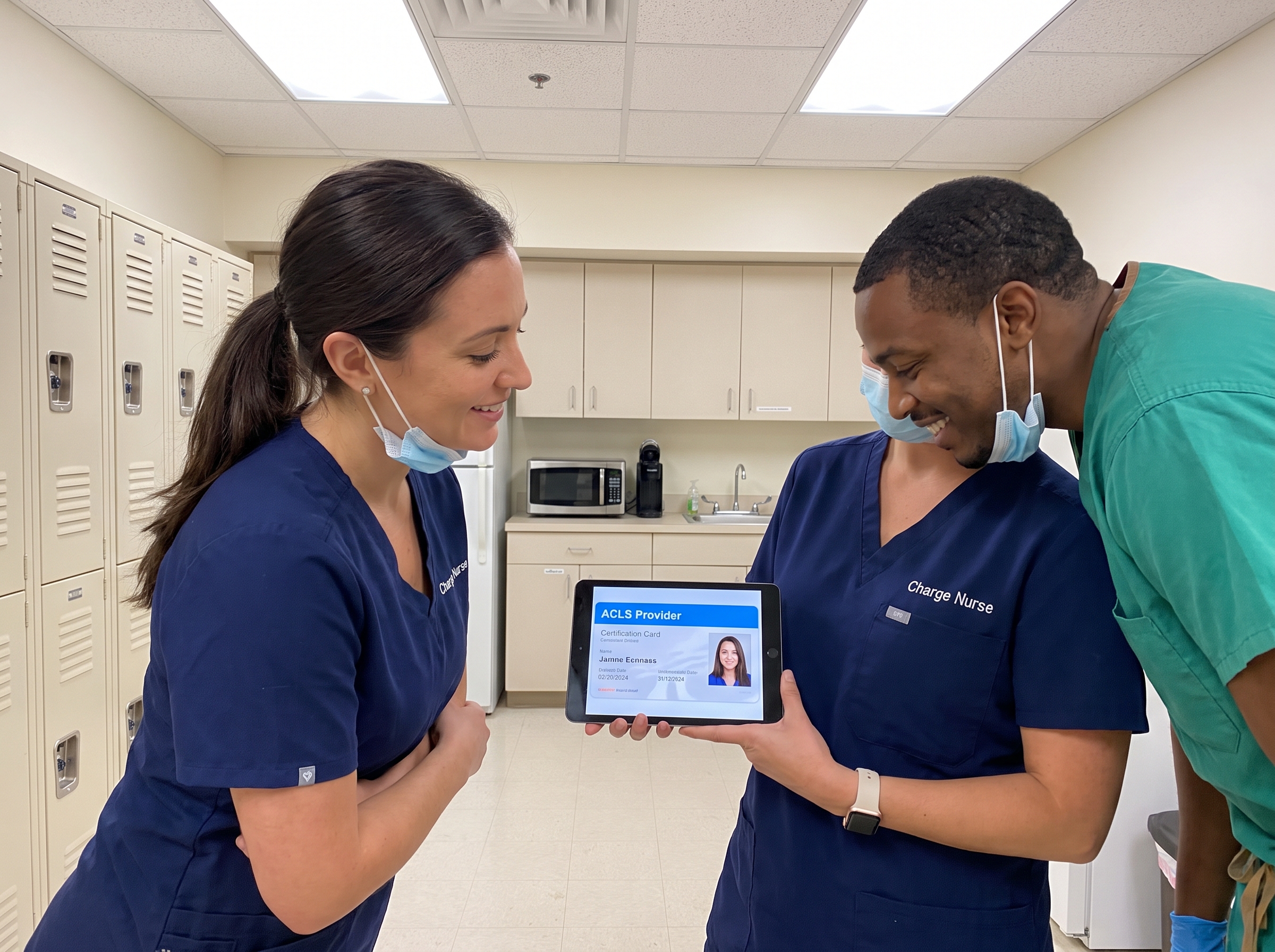
Charge nurse showing a newly downloaded ACLS certification card on a tablet to a colleague


This kind of last-minute gap is more common than it should be, and not because anyone was careless. Certifications sometimes lapse quietly during a busy stretch, a facility audit surfaces a card nobody flagged, or a new position opens up faster than anyone expected. Whatever the reason, the fix does not need to involve rescheduling a shift or delaying a start date by a week. It needs a certification path that can move as fast as the situation requires, which is exactly the gap same-day online certification is built to close.


Does Fast Mean Legitimate

It is a fair question, and anyone rushing to get certified should ask it: if a certification only takes a couple of hours, is it actually good enough to rely on. The speed of the process and the legitimacy of the certification are two separate things, and it helps to keep them separate when you are evaluating an option under time pressure.


The course content itself is built around current American Heart Association and International Liaison Committee on Resuscitation guidelines, the same clinical framework referenced across resuscitation training generally. The 2025 American Heart Association Guidelines for CPR and Emergency Cardiovascular Care, published in Circulation, and the accompanying guideline resources on cpr.heart.org lay out the resuscitation science that informs ACLS course content across the industry. What actually determines whether a certificate is "good enough" is not how many hours it took, but whether the specific employer or credentialing office accepts it, which is why confirming acceptance in advance is always worth the five-minute phone call. That is also why a money-back guarantee matters: if your certification is not accepted by your employer, that risk should not fall entirely on you. For a deeper look at how employers actually verify online certifications, this article on employer verification walks through exactly what credentialing offices check.


Is a Fast Course Skipping Content

A related worry is that a short course must be a shallow one. In practice, the 1 to 2 hour timeline reflects a course built around essential, exam-relevant content rather than padded lecture time, unlimited retakes rather than a single high-stakes test date, and self-paced modules rather than a rigid classroom schedule. None of that changes what you are tested on. It changes how much unrelated material and dead time sits between you and the exam.


If you want to slow down and study more thoroughly before testing, nothing about a self-paced format prevents that. You can take a day, a week, or longer to work through the material if that is what you need, and the course will still be waiting exactly where you left it. The speed is available when you need it, not forced on you when you do not. This look at course duration and learning quality goes deeper into how self-paced formats balance the two.


It also helps to remember that the exam itself, not the clock, is what determines whether you are certified. A rushed pass and an unhurried pass count exactly the same once you meet the passing standard, and unlimited retakes mean there is no penalty for taking an extra pass through a section on rhythm recognition or medication dosing before you sit for the exam. Same-day certification is a description of how fast the process can move when you need it to, not a rule that forces you to move that fast.


What To Do Right Now If You Need Your Card Today

If today is the deadline, here is the fastest reasonable sequence.


  • Confirm what you actually need. Check whether the requirement is ACLS specifically, or whether BLS or PALS is also required for the role, so you are not certifying twice.
  • Clear an uninterrupted block of time. Since the course typically takes 1 to 2 hours, set aside a window where you will not be pulled away mid-module.
  • Enroll and start immediately. Begin your ACLS certification as soon as your schedule allows rather than waiting for a more convenient day that may not come before your deadline.
  • Send the certificate the moment you pass. Forward the downloaded certificate to whoever is waiting on it, whether that is HR, a credentialing office, or a manager, the same day you finish.


This is also a good moment to double-check the expiration date on any certification you already hold, since a card that is set to lapse in a few weeks can create the exact same last-minute scramble later. Knowing how to read your certification card makes it easier to plan ahead instead of repeating today's rush in a year or two.


Frequently Asked Questions

Can I really finish ACLS certification in one sitting

Yes. The self-paced online course is typically completed in about 1 to 2 hours, and your certificate is available to download the moment you pass the exam. There is no mandatory waiting period built into the process.


Will my employer accept a certification I finished today

Most employers accept certifications based on whether the course content follows current AHA and ILCOR guidelines, not on how quickly the course was completed. It is still worth confirming acceptance with your specific credentialing office in advance, and choosing a provider that backs the certification with a money-back guarantee removes most of the risk if there is ever a question.


What if I fail the exam and I am short on time

Unlimited retakes are included at no extra charge, so a failed attempt does not mean starting over from scratch or paying again. You can review the material you missed and retest right away.


Do I need BLS or PALS certified the same day too

That depends on your role. Emergency department, ICU, and cardiac catheterization lab staff typically need active ACLS, while many other clinical roles require BLS as the baseline. If your position covers pediatric patients, PALS may also apply. Confirm exactly which certifications your specific role and facility require before you start, so you certify once instead of twice.


Is a same-day online course more work than a scheduled class

Not really. It is the same core content delivered in a format that does not require you to clear an entire day for travel, a classroom session, and a fixed test time. The difference is mostly in how the hours are spent: a scheduled class fills a full day around a fixed start time, while a self-paced course lets you use the time you actually have, whether that is one uninterrupted block or a few shorter sessions.


The Bottom Line

Same-day ACLS certification is real, but it specifically describes the online, self-paced path: a course typically finished in 1 to 2 hours, an exam with unlimited retakes, and a certificate you can download and use immediately. It does not describe the in-person route, which depends on class availability, travel, and sometimes a wait for a mailed card. If a manager, recruiter, or clinical placement coordinator needs proof of certification before the end of the day, the online path is the one built to deliver it, without asking you to trade away employer acceptance or guideline-based content to get there.


ACLS Blogs

How Fast Can You Get ACLS Certified? Same-Day Options Explained

How Fast Can You Actually Get ACLS Certified

A manager calls on a Thursday afternoon needing a nurse credentialed for a Friday morning shift. A recruiter is finalizing a travel assignment and the facility will not confirm the placement until an ACLS card is on file. A new hire is starting orientation tomorrow and human resources just flagged a missing certification. In every one of these situations, the question is the same: how fast can you actually get ACLS certified.


The honest answer depends entirely on which path you choose. A self-paced online ACLS course can realistically put a downloadable certificate in your hands within a couple of hours. Finding, scheduling, and attending an in-person class is a different timeline altogether, one measured in days or weeks rather than minutes. This guide breaks down both paths so you know exactly what "same-day" really means, what it does not mean, and how to move quickly without cutting corners on the certification itself.


Healthcare staffing runs on tight margins right now, and credentialing gaps are a common reason a start date slips. When every other piece of paperwork is ready and a life support certification is the last box left unchecked, the format of the course you choose determines whether that gap closes in an afternoon or drags into next week. Understanding the realistic timeline for each option, before you are staring down a deadline, makes it much easier to act quickly and with confidence when the pressure is actually on.


What "Same-Day ACLS Certification" Actually Means

"Same-day" is an accurate description of the online path, but it is worth being precise about what happens in that day. An online, self-paced ACLS course is typically completed in about 1 to 2 hours, covering the core content areas: cardiac arrest algorithms, bradycardia and tachycardia management, acute coronary syndromes, stroke recognition, and the medications used during a code. Because the course is self-paced with no scheduled start time and no classroom to sit in, you move through the material at your own speed, save progress if you need to step away, and take the exam whenever you are ready.

Nurse completing a self-paced online ACLS certification course on a laptop


Once you pass, the certificate is available immediately. There is no waiting for a card to arrive in the mail and no gap between finishing your exam and having proof of certification in hand. You can download it, print it, and forward it to a credentialing office, a staffing agency, or a hiring manager the same afternoon you started the course. For anyone reading this because a deadline is closing in today, that immediate digital access is the detail that matters most, and it is one of the clearest advantages of choosing an online route over an in-person one when time is short. If you want a broader walkthrough of how the process works end to end, this 3-step breakdown covers enrollment through certificate download in more detail.


The In-Person Route: What "Fast" Really Looks Like

In-person ACLS classes are not slow because the instructors are slow. They are slow because of everything that happens before you ever sit down in the classroom. First you have to find a class, which means checking a training center's calendar for open dates near you. Then you have to check seat availability, because most in-person sessions cap enrollment and popular time slots fill up days or weeks in advance. If the closest open seat is two towns over, you are also factoring in travel time and possibly time off work just to attend a single day of training.


Even after the class itself is finished, some in-person and blended programs do not hand you a card on the spot. Depending on the training center, you may wait for a physical card to be processed and mailed, which adds days to a timeline that already started with a multi-day search for an open seat. None of this makes in-person training a bad choice for people who prefer hands-on skills practice and have the lead time to plan around it. It simply is not a same-day option, and it was never designed to be one. For a fuller side-by-side comparison of the two formats, including where each one makes sense, see this comparison of online versus in-person ACLS certification.


Your Realistic Path to a Card Today

If the goal is a certificate in hand before the end of the day, the online path is the only one built for that timeline. Here is what the process actually looks like when you start it this morning and need it finished by this afternoon.


  • Enroll in the course. Sign up for ACLS certification from your phone, tablet, or computer. There is no waiting period between enrolling and starting the material.
  • Work through the self-paced modules. Most learners finish the core content in 1 to 2 hours, though the course has no time limit if you need to pause and come back.
  • Take the exam. If you do not pass on the first attempt, unlimited retakes are included at no extra charge, so a rough first pass on an unfamiliar rhythm strip does not cost you the day.
  • Download your certificate. Once you pass, your digital certificate is available to download and print immediately, with no wait for a physical card to be mailed.


That is the entire timeline. There is no scheduling step, no travel step, and no mailing step. For a look at how the full enrollment-to-certificate flow works across all three certifications, this overview of getting ACLS, BLS, and PALS certification online walks through each one.


Who Actually Needs Their Card Today

The pressure to get certified immediately usually comes from one of a few predictable situations. A department manager may have a scheduling gap tomorrow and needs to confirm that a floater or per diem nurse is current before assigning them to a unit. A staffing agency recruiter may be holding a placement open while a facility's credentialing office waits on documentation. A new hire may have an orientation date locked in and cannot start clinical rotations without proof of certification on file. A dental office, urgent care clinic, or outpatient surgery center may have just discovered during an audit that a provider's card lapsed weeks ago and needs it resolved before the next patient day.


In each case, the person under pressure is rarely the one who will sit through the course. It is a manager coordinating a team, a recruiter managing a placement, or a clinical placement coordinator trying to close a compliance gap before a start date. Knowing that a same-day online option exists changes how that conversation goes: instead of pushing a start date back to accommodate a class schedule, the certification itself stops being the bottleneck. Facilities and staffing agencies that credential frequently often build this timeline into their process, since travel and per diem placements typically require current life support certifications on file before a clinician can start an assignment, and compliance teams increasingly document exactly which certifications are verified and when, as outlined in this credentialing documentation checklist.

Charge nurse showing a newly downloaded ACLS certification card on a tablet to a colleague


This kind of last-minute gap is more common than it should be, and not because anyone was careless. Certifications sometimes lapse quietly during a busy stretch, a facility audit surfaces a card nobody flagged, or a new position opens up faster than anyone expected. Whatever the reason, the fix does not need to involve rescheduling a shift or delaying a start date by a week. It needs a certification path that can move as fast as the situation requires, which is exactly the gap same-day online certification is built to close.


Does Fast Mean Legitimate

It is a fair question, and anyone rushing to get certified should ask it: if a certification only takes a couple of hours, is it actually good enough to rely on. The speed of the process and the legitimacy of the certification are two separate things, and it helps to keep them separate when you are evaluating an option under time pressure.


The course content itself is built around current American Heart Association and International Liaison Committee on Resuscitation guidelines, the same clinical framework referenced across resuscitation training generally. The 2025 American Heart Association Guidelines for CPR and Emergency Cardiovascular Care, published in Circulation, and the accompanying guideline resources on cpr.heart.org lay out the resuscitation science that informs ACLS course content across the industry. What actually determines whether a certificate is "good enough" is not how many hours it took, but whether the specific employer or credentialing office accepts it, which is why confirming acceptance in advance is always worth the five-minute phone call. That is also why a money-back guarantee matters: if your certification is not accepted by your employer, that risk should not fall entirely on you. For a deeper look at how employers actually verify online certifications, this article on employer verification walks through exactly what credentialing offices check.


Is a Fast Course Skipping Content

A related worry is that a short course must be a shallow one. In practice, the 1 to 2 hour timeline reflects a course built around essential, exam-relevant content rather than padded lecture time, unlimited retakes rather than a single high-stakes test date, and self-paced modules rather than a rigid classroom schedule. None of that changes what you are tested on. It changes how much unrelated material and dead time sits between you and the exam.


If you want to slow down and study more thoroughly before testing, nothing about a self-paced format prevents that. You can take a day, a week, or longer to work through the material if that is what you need, and the course will still be waiting exactly where you left it. The speed is available when you need it, not forced on you when you do not. This look at course duration and learning quality goes deeper into how self-paced formats balance the two.


It also helps to remember that the exam itself, not the clock, is what determines whether you are certified. A rushed pass and an unhurried pass count exactly the same once you meet the passing standard, and unlimited retakes mean there is no penalty for taking an extra pass through a section on rhythm recognition or medication dosing before you sit for the exam. Same-day certification is a description of how fast the process can move when you need it to, not a rule that forces you to move that fast.


What To Do Right Now If You Need Your Card Today

If today is the deadline, here is the fastest reasonable sequence.


  • Confirm what you actually need. Check whether the requirement is ACLS specifically, or whether BLS or PALS is also required for the role, so you are not certifying twice.
  • Clear an uninterrupted block of time. Since the course typically takes 1 to 2 hours, set aside a window where you will not be pulled away mid-module.
  • Enroll and start immediately. Begin your ACLS certification as soon as your schedule allows rather than waiting for a more convenient day that may not come before your deadline.
  • Send the certificate the moment you pass. Forward the downloaded certificate to whoever is waiting on it, whether that is HR, a credentialing office, or a manager, the same day you finish.


This is also a good moment to double-check the expiration date on any certification you already hold, since a card that is set to lapse in a few weeks can create the exact same last-minute scramble later. Knowing how to read your certification card makes it easier to plan ahead instead of repeating today's rush in a year or two.


Frequently Asked Questions

Can I really finish ACLS certification in one sitting

Yes. The self-paced online course is typically completed in about 1 to 2 hours, and your certificate is available to download the moment you pass the exam. There is no mandatory waiting period built into the process.


Will my employer accept a certification I finished today

Most employers accept certifications based on whether the course content follows current AHA and ILCOR guidelines, not on how quickly the course was completed. It is still worth confirming acceptance with your specific credentialing office in advance, and choosing a provider that backs the certification with a money-back guarantee removes most of the risk if there is ever a question.


What if I fail the exam and I am short on time

Unlimited retakes are included at no extra charge, so a failed attempt does not mean starting over from scratch or paying again. You can review the material you missed and retest right away.


Do I need BLS or PALS certified the same day too

That depends on your role. Emergency department, ICU, and cardiac catheterization lab staff typically need active ACLS, while many other clinical roles require BLS as the baseline. If your position covers pediatric patients, PALS may also apply. Confirm exactly which certifications your specific role and facility require before you start, so you certify once instead of twice.


Is a same-day online course more work than a scheduled class

Not really. It is the same core content delivered in a format that does not require you to clear an entire day for travel, a classroom session, and a fixed test time. The difference is mostly in how the hours are spent: a scheduled class fills a full day around a fixed start time, while a self-paced course lets you use the time you actually have, whether that is one uninterrupted block or a few shorter sessions.


The Bottom Line

Same-day ACLS certification is real, but it specifically describes the online, self-paced path: a course typically finished in 1 to 2 hours, an exam with unlimited retakes, and a certificate you can download and use immediately. It does not describe the in-person route, which depends on class availability, travel, and sometimes a wait for a mailed card. If a manager, recruiter, or clinical placement coordinator needs proof of certification before the end of the day, the online path is the one built to deliver it, without asking you to trade away employer acceptance or guideline-based content to get there.


blogs

More articles for you

all articles

Start Today!

Get certified at your own pace, on your schedule, from the comfort of your home.