ACLS Blogs

Do CE Hours Count Toward ACLS? Recertification vs Continuing Education

The Question Every Nurse Eventually Asks

You open your license renewal portal and see a tidy checklist: 30 contact hours, a few state-mandated topics, a deadline. Then you glance at your wallet and realize your ACLS card expires next month. A natural thought follows. "I have been logging continuing education all year. Doesn't that cover it?"


It is one of the most common points of confusion in nursing, and the short answer is no. Continuing education (CE) hours and ACLS recertification are two separate requirements that come from two separate places, and one does not automatically satisfy the other. This article untangles the difference, explains where the two do overlap, and gives you a simple way to check what applies to your situation. If you are looking for a broader overview of CE as a concept, our complete guide to CE credits for healthcare professionals covers that ground. Here we focus on the specific ACLS-versus-CE question.


The Short Answer: CE Hours Do Not Replace a Current ACLS Card

Think of CE hours and an ACLS card as answering two different questions. CE hours answer the question your state board of nursing asks: "Has this nurse kept learning during the licensing period?" An ACLS card answers the question your employer, credentialing office, or unit manager asks: "Can this clinician demonstrate current competency in advanced cardiovascular life support?"


Because those questions are different, the documents that answer them are different. Fifteen hours of pharmacology CE will not show a hiring manager that you have completed an ACLS course based on current AHA and ILCOR guidelines. And a freshly renewed ACLS card does not, by default, check any box on your license renewal form.


  • CE hours are typically a licensing requirement set by your state board of nursing or another regulator.
  • ACLS certification is typically an employment, privileging, or credentialing requirement set by your employer or program.
  • Overlap is possible but never assumed. Some ACLS courses may carry CE credit, depending on who accredited them and whether your board accepts that accreditation.


Two Requirements, Two Different Gatekeepers

Where CE Requirements Come From

Continuing education requirements are a function of licensure. According to the National Council of State Boards of Nursing (NCSBN), licensure requirements vary by state, and a majority of states require nurses to complete continuing education before renewing a license. Some states require a set number of hours, some require specific topics, and some have no CE requirement at all. Renewal cycles differ as well, with two years being common but not universal.


In the nursing world, CE is usually measured in contact hours. The American Nurses Credentialing Center (ANCC) defines a contact hour as a unit that describes sixty minutes of an organized learning activity, and it accredits organizations that award nursing continuing professional development. You can read more on how this works in the ANCC accreditation FAQs. The key point is that credit exists because a recognized body approved the activity, not because the topic sounds clinical.


Where the ACLS Requirement Comes From

ACLS is different. In most cases no state regulator is asking for it on your license renewal form. Instead, the requirement usually lives in your job description, your unit's policy, or your hospital's credentialing rules. ICU, ED, telemetry, PACU, and rapid response roles commonly expect a current ACLS card, and your employer decides what proof they will accept.


Standard ACLS cards are valid for two years. The AHA states that course completion cards are valid for two years through the end of the month in which the card was issued. When that month passes, the card is expired, no matter how many CE hours you have in your folder. If you want a deeper walk-through of what happens at that point, see our article on what happens if your ACLS certification expires.


Why the Two Get Confused

The mix-up is understandable, and it usually comes from one of a few places.


They Often Land on the Same Calendar

Many nurses renew their license every two years, and ACLS cards also run on a two-year cycle. When both deadlines arrive in the same season, they start to feel like one task. They are not. Each has its own paperwork, its own proof, and its own consequences if it lapses.


The Vocabulary Overlaps

People say "I need to get my ACLS hours done," "I need my renewal hours," and "I need my CE" almost interchangeably. But "hours" means something specific in each case. A CE contact hour is a unit of credit. The time you spend in an ACLS renewal course is simply how long the course takes. Whether those minutes also convert to credit is a separate question with a separate answer.


Some Courses Do Offer Both

The final source of confusion is the most legitimate one. Some ACLS courses are offered with CE or CME credit attached. The AHA itself notes that it offers CE credits for some of its courses, that availability varies by course and profession, and that it is not an accrediting agency. It also advises that if you need CE credit, you should contact your own accrediting body to see whether they will accept it. That one statement captures the whole issue: credit is course-specific and profession-specific, and the final word belongs to your board.
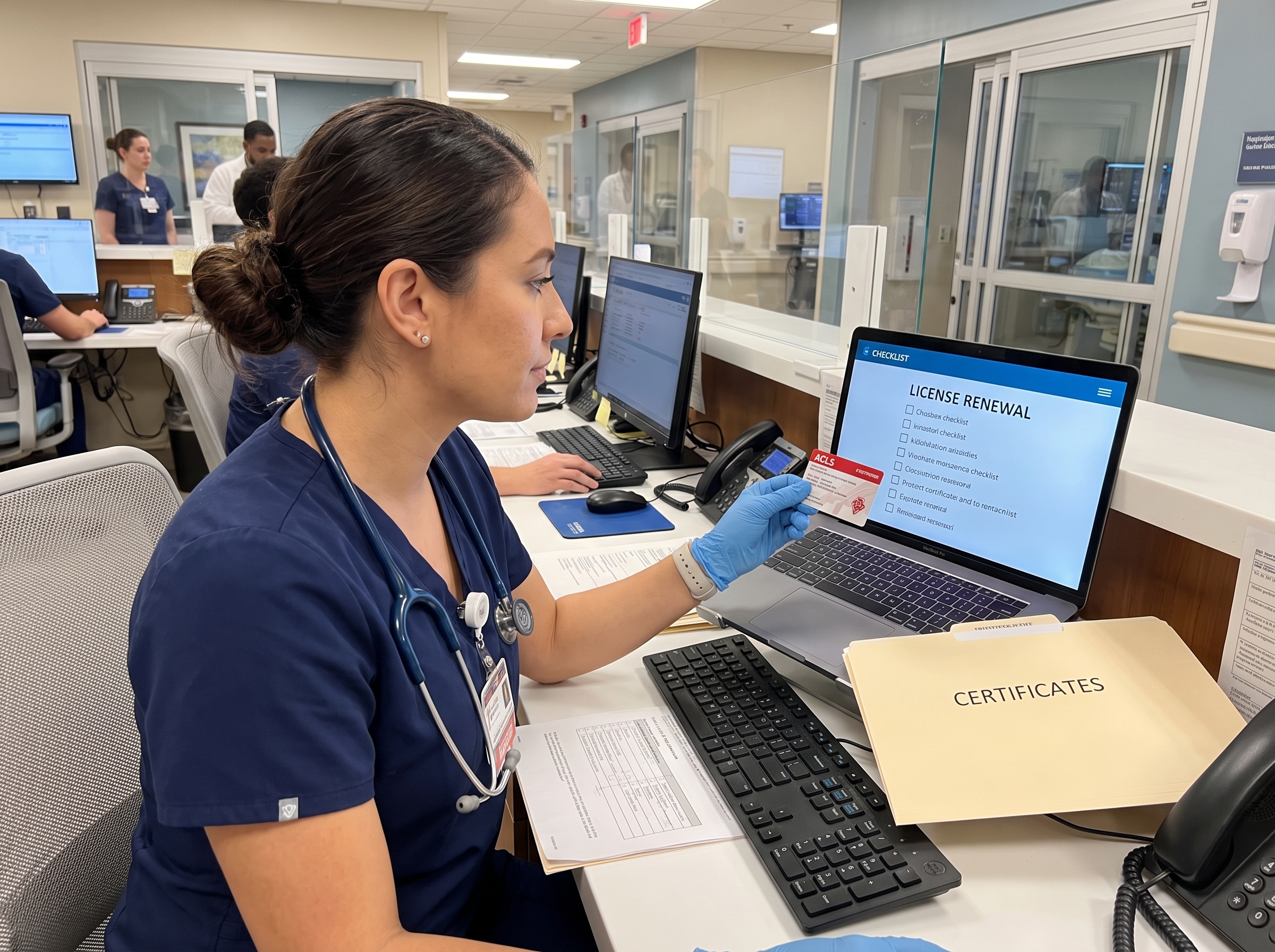
Nurse comparing license renewal checklist with ACLS card


ACLS Recertification vs. Continuing Education at a Glance

Here is a side-by-side way to think about the two requirements.


  • Purpose: CE supports ongoing professional learning for licensure. ACLS recertification confirms current competency in resuscitation skills and algorithms.
  • Who sets the rule: CE is typically set by your state board. ACLS is typically set by your employer or credentialing body.
  • Proof you hold: CE is documented with certificates or a transcript from an approved provider. ACLS is documented with a course completion card or certificate.
  • Cycle: CE follows your license renewal period. ACLS follows the card validity period, commonly two years.
  • Can one substitute for the other? Not automatically. An accredited ACLS course might count toward CE if your board accepts it, but CE hours never substitute for a current ACLS card.


The Two Directions of Overlap

It helps to separate the two directions in which people hope the overlap works.


Direction 1: Using CE Hours to Satisfy ACLS

This is the direction that does not work. General CE, even a clinically relevant cardiology module, is not the same as completing an ACLS course. Employers asking for ACLS want evidence that you completed a recognized course covering the core content: cardiac arrest algorithms, bradycardia and tachycardia management, acute coronary syndromes, stroke recognition, post-cardiac arrest care, team dynamics, and the medications and defibrillation skills that go with them. A stack of unrelated CE certificates does not show that.


Direction 2: Using an ACLS Course to Earn CE

This direction can work, but only under conditions. For an ACLS course to count toward your license renewal, three things generally need to be true:


  • The course must actually award CE or contact hours, and the provider must say so clearly.
  • The credit must come from an accrediting or approving body your board recognizes (for nurses, many boards recognize ANCC-accredited or ANCC-approved providers, but this is a board-by-board question).
  • Your board must allow that type of credit for your renewal category. Some boards cap or restrict hours earned in certain topic areas.


If any one of those conditions fails, the course is still valid for meeting an employer's ACLS requirement, but it will not move your CE total. This is why we recommend never assuming credit. Read the course description, find out whether CE is offered at all, and confirm with your board before you count on it.


How to Check What Counts for You

Rather than guessing, run through a short verification routine. It takes about ten minutes and prevents a very stressful surprise at renewal time.


  1. Pull up your board's renewal requirements. Your state board of nursing website lists the number of hours, required topics, and the renewal period. The NCSBN also publishes a nurse licensure guidance tool that points you to state-specific information.
  2. Look for acceptance language. Find out which providers or accrediting bodies the board accepts, and whether there are restrictions on life support courses.
  3. Check the course details. If you are hoping an ACLS course earns credit, look for explicit statements about credit, the accrediting body, and the number of contact hours. If the course page is silent, treat the answer as "no credit" until the provider tells you otherwise.
  4. Ask your employer what they accept for ACLS. Employers set their own standards. Confirm that the course format you plan to take meets your unit's requirements before you enroll.
  5. Keep both sets of documents. Store your CE certificates and your ACLS card separately, and note both expiration dates in your calendar.


A note on what we can and cannot tell you here: Affordable ACLS courses are built around current AHA and ILCOR guidelines, and the company's focus is certification and recertification. We are not telling you that any particular course awards CE credit. If CE credit matters to you, check the course details and your own board's rules before you count on it. If you want to understand how the certification and renewal paths differ, our guide to ACLS certification vs. recertification is a useful companion.


Common Scenarios, Worked Through

Scenario 1: "I Finished All My CE, So I Can Skip ACLS Renewal"

Not so fast. Finishing your CE satisfies your board. Your employer's ACLS policy is a separate matter. If your card expires and your unit requires current certification, you may be pulled from certain duties or scheduling until it is renewed, regardless of how many CE hours you hold. In that case, the practical move is to renew the card. Online recertification is an efficient way to do it, and our article on how long online ACLS recertification takes breaks down the time commitment so you can plan around your shifts.


Scenario 2: "I Took an ACLS Course, Where Are My CE Hours?"

If you completed a course and expected CE credit but did not receive any, go back to the course description. Credit is not automatic. Some courses are offered without any CE attached, some are offered with it, and some offer it only in certain formats or for certain professions. If the course did not advertise CE, you should not expect to log hours from it. If it did, request the credit documentation from the provider and confirm that your board accepts that accreditation.


Scenario 3: "My License and My ACLS Both Expire This Year"

This is common and very manageable. Treat them as two tasks with two deadlines. Put the earlier of the two on your calendar with a reminder, and work backward. CE can be spread across months in small pieces, while ACLS recertification is typically a single focused course you can complete in one or two sittings. Handling the card early also protects you from the scheduling friction that tends to appear when a lapse comes close to a license deadline.


Scenario 4: "I Work Per Diem or Travel, and Different Places Want Different Things"

The variation is the point here. Different facilities may specify different ACLS formats, and your license or licenses may carry different CE rules. Keep a short list of each employer's life support requirement and each board's CE rule. That is a small spreadsheet that saves a lot of last-minute phone calls.

Nurse completing online ACLS recertification on a tablet


Why Recertification Is Not Just Paperwork

It is tempting to treat ACLS renewal as a compliance chore, especially when CE feels more obviously educational. But recertification does something CE usually does not: it refreshes a specific, high-stakes, perishable skill set. Resuscitation knowledge fades when it is not used. Research on resuscitation training keeps returning to the same theme. For example, a randomized controlled study on retention of pediatric resuscitation skills looked at how reinforcing training between certifications affects how well skills hold up months later. The takeaway for working nurses is that periodic, structured refreshers matter.


Many nurses will go months between actual codes. Then a patient becomes unresponsive and the algorithm needs to be in your head, not in a drawer. If you want practical ideas for staying sharp between renewals, read our piece on why ACLS skills decay between recertifications.


Renewing Your ACLS Without Waiting for CE to Line Up

Because the two requirements are independent, you do not need to coordinate them. You can renew your ACLS whenever your card is approaching its end date, and you can complete CE on whatever schedule your board allows. If you are a working nurse with an expiring card, the most direct path is the ACLS recertification course, which is self-paced, can be completed from a phone, tablet, or computer, and gives you digital certification as soon as you finish. Unlimited retakes are included, and there is a money-back guarantee if your employer does not accept the certification. Current pricing is on the course page.


If you are earning your first card rather than renewing, the main ACLS certification and recertification page shows both options in one place. And if you want the full picture of the renewal process, including timing and requirements, our guide to renewing your certification walks through the steps.


Quick Answers to Common Questions

Do CE hours count toward ACLS?

No. General CE hours do not replace completing an ACLS course or holding a current ACLS card. They serve a different purpose and are tracked by a different organization.


Can an ACLS course count as CE?

Sometimes. It depends on whether the specific course offers CE, who accredited it, and whether your board accepts that credit. Check the course details and confirm with your board.


Does my employer care about my CE hours?

Usually they care that your license is active, which indirectly depends on CE. For life support, they care about your ACLS card. Ask your manager or education department what they require.


If I let my ACLS lapse, do my CE hours protect me?

No. A lapsed card is a lapsed card, and CE hours do not change that. Renewing before the end of the month shown on your card keeps things simple.


Where do I find out what my board accepts?

Start with your state board of nursing website and the renewal section. If the language is unclear, contact the board directly. Get answers in writing when you can.


Key Takeaways

  • CE hours and ACLS recertification are separate requirements with separate gatekeepers: your board for CE, your employer for ACLS.
  • CE hours never replace a current ACLS card.
  • An ACLS course counts toward CE only if it clearly awards credit and your board accepts the accrediting body.
  • Verify rather than assume: check your board's rules, the course details, and your employer's policy.
  • Track both expiration dates, and renew your ACLS card on its own timeline.


The two requirements will always live side by side in a nursing career. Once you know which question each one answers, you can handle them calmly and in the right order, and your next renewal season gets a lot less stressful.


ACLS Blogs

Do CE Hours Count Toward ACLS? Recertification vs Continuing Education

Continuing education hours and ACLS recertification are two separate requirements, and one does not automatically satisfy the other. Here is how they differ, where they can overlap, and how to check what counts for you.

The Question Every Nurse Eventually Asks

You open your license renewal portal and see a tidy checklist: 30 contact hours, a few state-mandated topics, a deadline. Then you glance at your wallet and realize your ACLS card expires next month. A natural thought follows. "I have been logging continuing education all year. Doesn't that cover it?"


It is one of the most common points of confusion in nursing, and the short answer is no. Continuing education (CE) hours and ACLS recertification are two separate requirements that come from two separate places, and one does not automatically satisfy the other. This article untangles the difference, explains where the two do overlap, and gives you a simple way to check what applies to your situation. If you are looking for a broader overview of CE as a concept, our complete guide to CE credits for healthcare professionals covers that ground. Here we focus on the specific ACLS-versus-CE question.


The Short Answer: CE Hours Do Not Replace a Current ACLS Card

Think of CE hours and an ACLS card as answering two different questions. CE hours answer the question your state board of nursing asks: "Has this nurse kept learning during the licensing period?" An ACLS card answers the question your employer, credentialing office, or unit manager asks: "Can this clinician demonstrate current competency in advanced cardiovascular life support?"


Because those questions are different, the documents that answer them are different. Fifteen hours of pharmacology CE will not show a hiring manager that you have completed an ACLS course based on current AHA and ILCOR guidelines. And a freshly renewed ACLS card does not, by default, check any box on your license renewal form.


  • CE hours are typically a licensing requirement set by your state board of nursing or another regulator.
  • ACLS certification is typically an employment, privileging, or credentialing requirement set by your employer or program.
  • Overlap is possible but never assumed. Some ACLS courses may carry CE credit, depending on who accredited them and whether your board accepts that accreditation.


Two Requirements, Two Different Gatekeepers

Where CE Requirements Come From

Continuing education requirements are a function of licensure. According to the National Council of State Boards of Nursing (NCSBN), licensure requirements vary by state, and a majority of states require nurses to complete continuing education before renewing a license. Some states require a set number of hours, some require specific topics, and some have no CE requirement at all. Renewal cycles differ as well, with two years being common but not universal.


In the nursing world, CE is usually measured in contact hours. The American Nurses Credentialing Center (ANCC) defines a contact hour as a unit that describes sixty minutes of an organized learning activity, and it accredits organizations that award nursing continuing professional development. You can read more on how this works in the ANCC accreditation FAQs. The key point is that credit exists because a recognized body approved the activity, not because the topic sounds clinical.


Where the ACLS Requirement Comes From

ACLS is different. In most cases no state regulator is asking for it on your license renewal form. Instead, the requirement usually lives in your job description, your unit's policy, or your hospital's credentialing rules. ICU, ED, telemetry, PACU, and rapid response roles commonly expect a current ACLS card, and your employer decides what proof they will accept.


Standard ACLS cards are valid for two years. The AHA states that course completion cards are valid for two years through the end of the month in which the card was issued. When that month passes, the card is expired, no matter how many CE hours you have in your folder. If you want a deeper walk-through of what happens at that point, see our article on what happens if your ACLS certification expires.


Why the Two Get Confused

The mix-up is understandable, and it usually comes from one of a few places.


They Often Land on the Same Calendar

Many nurses renew their license every two years, and ACLS cards also run on a two-year cycle. When both deadlines arrive in the same season, they start to feel like one task. They are not. Each has its own paperwork, its own proof, and its own consequences if it lapses.


The Vocabulary Overlaps

People say "I need to get my ACLS hours done," "I need my renewal hours," and "I need my CE" almost interchangeably. But "hours" means something specific in each case. A CE contact hour is a unit of credit. The time you spend in an ACLS renewal course is simply how long the course takes. Whether those minutes also convert to credit is a separate question with a separate answer.


Some Courses Do Offer Both

The final source of confusion is the most legitimate one. Some ACLS courses are offered with CE or CME credit attached. The AHA itself notes that it offers CE credits for some of its courses, that availability varies by course and profession, and that it is not an accrediting agency. It also advises that if you need CE credit, you should contact your own accrediting body to see whether they will accept it. That one statement captures the whole issue: credit is course-specific and profession-specific, and the final word belongs to your board.

Nurse comparing license renewal checklist with ACLS card


ACLS Recertification vs. Continuing Education at a Glance

Here is a side-by-side way to think about the two requirements.


  • Purpose: CE supports ongoing professional learning for licensure. ACLS recertification confirms current competency in resuscitation skills and algorithms.
  • Who sets the rule: CE is typically set by your state board. ACLS is typically set by your employer or credentialing body.
  • Proof you hold: CE is documented with certificates or a transcript from an approved provider. ACLS is documented with a course completion card or certificate.
  • Cycle: CE follows your license renewal period. ACLS follows the card validity period, commonly two years.
  • Can one substitute for the other? Not automatically. An accredited ACLS course might count toward CE if your board accepts it, but CE hours never substitute for a current ACLS card.


The Two Directions of Overlap

It helps to separate the two directions in which people hope the overlap works.


Direction 1: Using CE Hours to Satisfy ACLS

This is the direction that does not work. General CE, even a clinically relevant cardiology module, is not the same as completing an ACLS course. Employers asking for ACLS want evidence that you completed a recognized course covering the core content: cardiac arrest algorithms, bradycardia and tachycardia management, acute coronary syndromes, stroke recognition, post-cardiac arrest care, team dynamics, and the medications and defibrillation skills that go with them. A stack of unrelated CE certificates does not show that.


Direction 2: Using an ACLS Course to Earn CE

This direction can work, but only under conditions. For an ACLS course to count toward your license renewal, three things generally need to be true:


  • The course must actually award CE or contact hours, and the provider must say so clearly.
  • The credit must come from an accrediting or approving body your board recognizes (for nurses, many boards recognize ANCC-accredited or ANCC-approved providers, but this is a board-by-board question).
  • Your board must allow that type of credit for your renewal category. Some boards cap or restrict hours earned in certain topic areas.


If any one of those conditions fails, the course is still valid for meeting an employer's ACLS requirement, but it will not move your CE total. This is why we recommend never assuming credit. Read the course description, find out whether CE is offered at all, and confirm with your board before you count on it.


How to Check What Counts for You

Rather than guessing, run through a short verification routine. It takes about ten minutes and prevents a very stressful surprise at renewal time.


  1. Pull up your board's renewal requirements. Your state board of nursing website lists the number of hours, required topics, and the renewal period. The NCSBN also publishes a nurse licensure guidance tool that points you to state-specific information.
  2. Look for acceptance language. Find out which providers or accrediting bodies the board accepts, and whether there are restrictions on life support courses.
  3. Check the course details. If you are hoping an ACLS course earns credit, look for explicit statements about credit, the accrediting body, and the number of contact hours. If the course page is silent, treat the answer as "no credit" until the provider tells you otherwise.
  4. Ask your employer what they accept for ACLS. Employers set their own standards. Confirm that the course format you plan to take meets your unit's requirements before you enroll.
  5. Keep both sets of documents. Store your CE certificates and your ACLS card separately, and note both expiration dates in your calendar.


A note on what we can and cannot tell you here: Affordable ACLS courses are built around current AHA and ILCOR guidelines, and the company's focus is certification and recertification. We are not telling you that any particular course awards CE credit. If CE credit matters to you, check the course details and your own board's rules before you count on it. If you want to understand how the certification and renewal paths differ, our guide to ACLS certification vs. recertification is a useful companion.


Common Scenarios, Worked Through

Scenario 1: "I Finished All My CE, So I Can Skip ACLS Renewal"

Not so fast. Finishing your CE satisfies your board. Your employer's ACLS policy is a separate matter. If your card expires and your unit requires current certification, you may be pulled from certain duties or scheduling until it is renewed, regardless of how many CE hours you hold. In that case, the practical move is to renew the card. Online recertification is an efficient way to do it, and our article on how long online ACLS recertification takes breaks down the time commitment so you can plan around your shifts.


Scenario 2: "I Took an ACLS Course, Where Are My CE Hours?"

If you completed a course and expected CE credit but did not receive any, go back to the course description. Credit is not automatic. Some courses are offered without any CE attached, some are offered with it, and some offer it only in certain formats or for certain professions. If the course did not advertise CE, you should not expect to log hours from it. If it did, request the credit documentation from the provider and confirm that your board accepts that accreditation.


Scenario 3: "My License and My ACLS Both Expire This Year"

This is common and very manageable. Treat them as two tasks with two deadlines. Put the earlier of the two on your calendar with a reminder, and work backward. CE can be spread across months in small pieces, while ACLS recertification is typically a single focused course you can complete in one or two sittings. Handling the card early also protects you from the scheduling friction that tends to appear when a lapse comes close to a license deadline.


Scenario 4: "I Work Per Diem or Travel, and Different Places Want Different Things"

The variation is the point here. Different facilities may specify different ACLS formats, and your license or licenses may carry different CE rules. Keep a short list of each employer's life support requirement and each board's CE rule. That is a small spreadsheet that saves a lot of last-minute phone calls.

Nurse completing online ACLS recertification on a tablet


Why Recertification Is Not Just Paperwork

It is tempting to treat ACLS renewal as a compliance chore, especially when CE feels more obviously educational. But recertification does something CE usually does not: it refreshes a specific, high-stakes, perishable skill set. Resuscitation knowledge fades when it is not used. Research on resuscitation training keeps returning to the same theme. For example, a randomized controlled study on retention of pediatric resuscitation skills looked at how reinforcing training between certifications affects how well skills hold up months later. The takeaway for working nurses is that periodic, structured refreshers matter.


Many nurses will go months between actual codes. Then a patient becomes unresponsive and the algorithm needs to be in your head, not in a drawer. If you want practical ideas for staying sharp between renewals, read our piece on why ACLS skills decay between recertifications.


Renewing Your ACLS Without Waiting for CE to Line Up

Because the two requirements are independent, you do not need to coordinate them. You can renew your ACLS whenever your card is approaching its end date, and you can complete CE on whatever schedule your board allows. If you are a working nurse with an expiring card, the most direct path is the ACLS recertification course, which is self-paced, can be completed from a phone, tablet, or computer, and gives you digital certification as soon as you finish. Unlimited retakes are included, and there is a money-back guarantee if your employer does not accept the certification. Current pricing is on the course page.


If you are earning your first card rather than renewing, the main ACLS certification and recertification page shows both options in one place. And if you want the full picture of the renewal process, including timing and requirements, our guide to renewing your certification walks through the steps.


Quick Answers to Common Questions

Do CE hours count toward ACLS?

No. General CE hours do not replace completing an ACLS course or holding a current ACLS card. They serve a different purpose and are tracked by a different organization.


Can an ACLS course count as CE?

Sometimes. It depends on whether the specific course offers CE, who accredited it, and whether your board accepts that credit. Check the course details and confirm with your board.


Does my employer care about my CE hours?

Usually they care that your license is active, which indirectly depends on CE. For life support, they care about your ACLS card. Ask your manager or education department what they require.


If I let my ACLS lapse, do my CE hours protect me?

No. A lapsed card is a lapsed card, and CE hours do not change that. Renewing before the end of the month shown on your card keeps things simple.


Where do I find out what my board accepts?

Start with your state board of nursing website and the renewal section. If the language is unclear, contact the board directly. Get answers in writing when you can.


Key Takeaways

  • CE hours and ACLS recertification are separate requirements with separate gatekeepers: your board for CE, your employer for ACLS.
  • CE hours never replace a current ACLS card.
  • An ACLS course counts toward CE only if it clearly awards credit and your board accepts the accrediting body.
  • Verify rather than assume: check your board's rules, the course details, and your employer's policy.
  • Track both expiration dates, and renew your ACLS card on its own timeline.


The two requirements will always live side by side in a nursing career. Once you know which question each one answers, you can handle them calmly and in the right order, and your next renewal season gets a lot less stressful.


blogs

More articles for you

all articles

Start Today!

Get certified at your own pace, on your schedule, from the comfort of your home.