ACLS Blogs

School-Based Cardiac Emergencies: How Teachers and Coaches Can Bridge the Gap Until EMS Arrives

When Every Second Counts: The School Cardiac Emergency No One Talks About Enough

Picture a Friday afternoon practice. The bleachers are half full of parents. A 16-year-old point guard sprints down the court, pulls up for a jump shot — and collapses. No warning. No clutching of the chest. Just down. In that moment, the most important medical professional on the scene is not the paramedic still five minutes away. It is the coach standing ten feet from that student.


This scenario plays out in American schools more often than most people realize. According to the American College of Cardiology, a recent analysis of 641 cases of sudden cardiac arrest (SCA) in young U.S. athletes found that over 60% occurred in high school athletes, with an overall survival rate of just 49%. That survival rate climbed to 72% when the cardiac arrest happened during exertion and bystanders responded quickly — proof that what happens in the first few minutes is everything. Teachers, coaches, and school staff are not backup responders. In most cardiac emergencies on school grounds, they are the first responders.

Coach performing CPR on collapsed student athlete in school gymnasium


Why Schools Are High-Risk Environments for Sudden Cardiac Arrest

Sudden cardiac arrest does not discriminate by age. While it is commonly associated with older adults, children and teenagers are far more vulnerable than most parents and educators understand. Structural heart conditions — many of them undetected — are present in approximately 1 in 300 youth, according to data from the Sudden Cardiac Arrest Foundation and NATA's inter-association task force. These conditions often produce no symptoms until a catastrophic event occurs.


Student athletes are at elevated risk specifically because physical exertion can trigger arrhythmias in hearts that carry these hidden conditions. Hypertrophic cardiomyopathy, long QT syndrome, commotio cordis from a blow to the chest — the causes are varied, but the outcome is the same: the heart stops pumping effectively, and the brain begins to suffer irreversible damage within four to six minutes. SCA is, by a significant margin, the leading cause of death among student athletes, accounting for more than half of all fatalities in that population.


The critical gap is this: average EMS response time in the United States ranges from 6 to 12 minutes in urban areas, and considerably longer in rural communities. When survival probability decreases by roughly 10% with every minute of delayed defibrillation, a 7-minute EMS response without bystander CPR and AED use translates to a survival probability that has already fallen by 70%. Teachers and coaches who are trained and prepared do not just help — they are often the only reason a student survives at all.


Recognizing Sudden Cardiac Arrest: What Teachers and Coaches Must Know

One of the most common barriers to fast action is misidentification. Sudden cardiac arrest is frequently confused with seizure activity, fainting, or heat exhaustion — all of which are more common and less immediately life-threatening. Knowing the difference is a core skill for anyone who works with students.


The hallmark signs of SCA include:


  • Sudden unresponsiveness: The student collapses without warning and does not respond to shouting or a sternal rub.
  • Absent or abnormal breathing: No breathing, or gasping (agonal breathing) that sounds labored and irregular.
  • No detectable pulse: Check the carotid artery in the neck. In a real emergency, do not spend more than 10 seconds on this check — if in doubt, begin CPR.
  • Rapid color change: Skin may turn pale, gray, or bluish, particularly around the lips and fingertips.

A key distinction: if a student appears to be having a seizure after collapsing during exertion, treat it as SCA until proven otherwise. Commotio cordis — SCA triggered by a blow to the chest — can cause what appears to be a brief seizure before the student becomes unresponsive. When in doubt, activate your emergency response plan immediately.


The Chain of Survival: Your Role in the First Four Minutes

The American Heart Association's Chain of Survival framework breaks cardiac emergency response into clear, sequential steps. For school-based emergencies, the first three links in that chain — recognition, CPR, and defibrillation — are entirely in the hands of bystanders before EMS arrives. Here is what that looks like in practice.


Step 1: Recognize and Activate the Emergency Response System

The moment you identify an unresponsive, non-breathing student, call out loudly. Designate specific people by pointing: "You — call 911 now. You — get the AED from the gym hallway." Do not issue general calls for help and hope someone acts. Assign roles. This is exactly what a Cardiac Emergency Response Plan (CERP), as recommended by the American Heart Association, is designed to formalize. Schools with an active CERP show dramatically higher survival rates than those without one.


Step 2: Begin High-Quality CPR Immediately

Do not wait for the AED. Do not wait for a nurse. Start chest compressions now. High-quality CPR is defined by:


  • Rate: 100 to 120 compressions per minute — think of pushing to the beat of "Stayin' Alive."
  • Depth: At least 2 inches for adults and older children. For young children, approximately 1.5 inches.
  • Full chest recoil: Allow the chest to rise completely between compressions. Do not lean on the chest.
  • Minimize interruptions: Keep pauses in compressions under 10 seconds. If you are the only person present, do not stop to check for a pulse until the AED arrives and prompts you.
  • 30:2 ratio: For trained rescuers, 30 compressions followed by 2 rescue breaths. If you are not trained in rescue breaths, continuous hands-only compressions are still highly effective for adults and older teens.

CPR is physically demanding. If another trained staff member is available, rotate compressors every two minutes to maintain compression quality. This is one reason why broad staff training — not just the athletic trainer or school nurse — saves lives.


For coaches and teachers who want to build or refresh these skills, BLS training specifically designed for sports and athletic settings covers CPR technique alongside other sideline emergencies like heat stroke and spinal injuries — all skills that any coach should have.


Step 3: Deploy the AED as Fast as Possible

An AED used within 3 minutes of collapse raises survival probability to approximately 70%. Used within 1 minute, that figure approaches 90%. The AED is not a device reserved for medical professionals — it is specifically designed to be used by anyone. The device talks you through every step.


When the AED arrives:


  • Power on the device and follow audio and visual prompts exactly.
  • Apply electrode pads to bare skin — one below the right collarbone, one on the lower left side of the chest. For children under 8 or weighing less than 55 pounds, use pediatric pads or the pediatric setting if available.
  • Ensure everyone stands clear while the AED analyzes the rhythm. Do not touch the student.
  • If a shock is advised, ensure all bystanders are clear, then press the shock button. Immediately resume CPR after delivering the shock.
  • If no shock is advised, continue CPR and follow device prompts until EMS arrives.

Understanding how AEDs work — and how they differ for adult versus pediatric patients — makes a critical difference in an emergency. Our complete guide to AEDs for adults and children walks through device types, pad placement, and the pediatric considerations every school staff member should understand.


Building a School Cardiac Emergency Response Plan

Individual knowledge is essential, but it is not sufficient on its own. A student's survival should not depend on whether a trained coach happens to be standing nearby. Schools need a systematic Cardiac Emergency Response Plan — a written, practiced protocol that ensures any cardiac emergency triggers an immediate, coordinated response.


According to guidance from Project ADAM (Automated Defibrillators in Adam's Memory), a nationally recognized school cardiac preparedness program, a complete CERP should include:


  • Strategic AED placement: AEDs should be accessible from any point on campus within 3 minutes. For large schools, this may mean multiple units in athletic facilities, hallways, and portable buildings.
  • Designated trained responders: Identify specific staff members responsible for CPR and AED response at all times, including during after-school events and weekend activities when regular staff may not be present.
  • Clear communication protocols: Who calls 911? Who retrieves the AED? Who manages the crowd? Who meets EMS at the entrance and escorts them to the scene? These roles must be pre-assigned.
  • AED maintenance schedule: AEDs must be inspected regularly. Expired pads or a dead battery render the device useless. Assign a responsible party for monthly checks.
  • Practice drills: A CERP that exists only on paper is far less effective than one practiced under simulated conditions. Evidence shows that conducting drills increases survival probability by up to 70%.

Schools that partner with their local EMS providers to run live drills — where staff physically retrieve the AED, perform CPR on a mannequin, and hand off to arriving paramedics — demonstrate dramatically faster response times in real emergencies. This type of practice removes hesitation, the most dangerous enemy in a cardiac emergency.

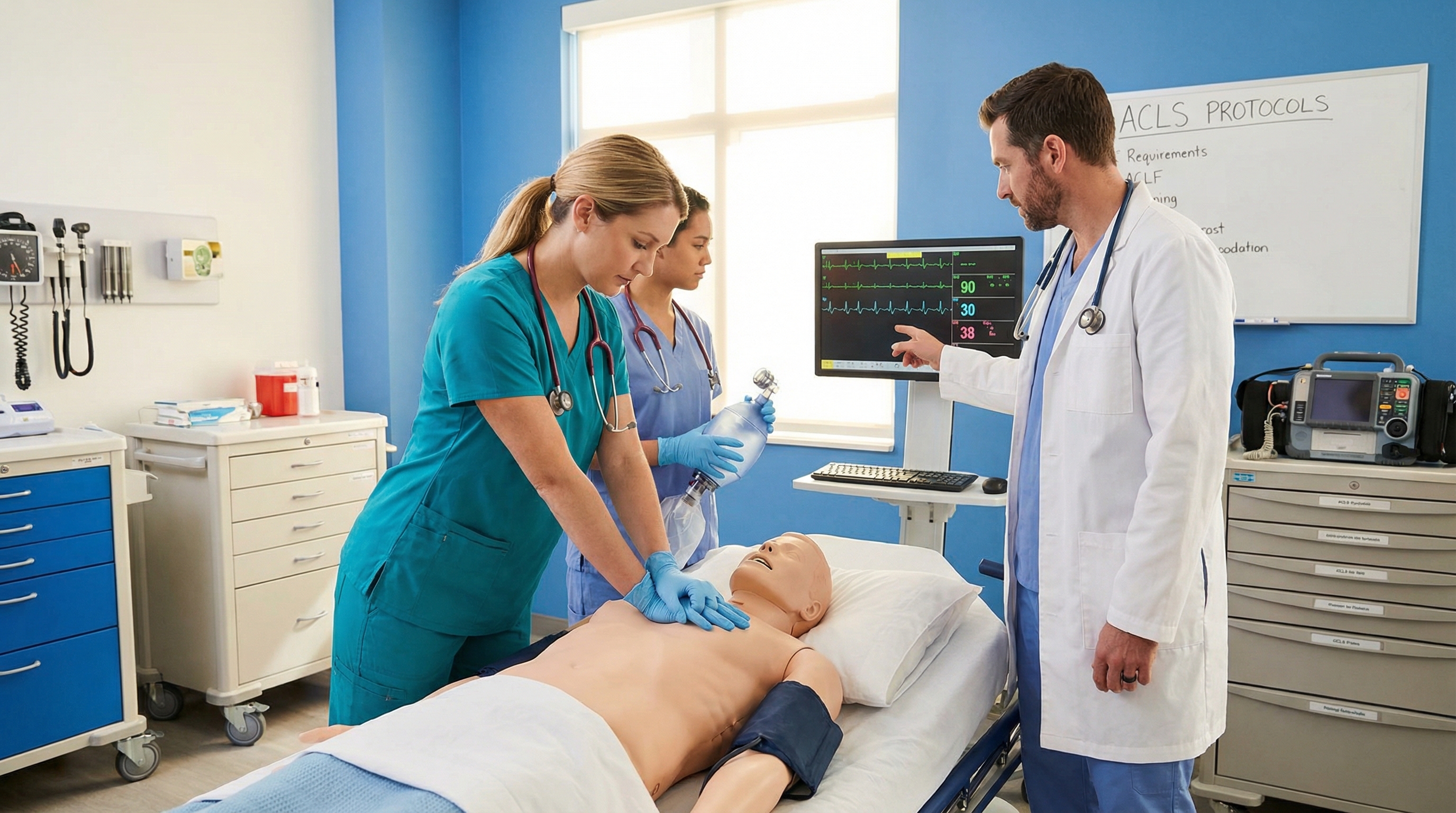
School staff participating in AED and CPR training demonstration


Who in Your School Should Be BLS-Certified?

The question is not whether teachers and coaches should have CPR and BLS training — the answer is clearly yes. The question is how broadly that training should extend and how to make it achievable for busy school staff.


The National Federation of State High School Associations (NFHS) recommends that at minimum, 10% of all school staff, 50% of coaches, and 50% of physical education staff maintain current CPR and AED certification, renewed at least every two years. In practice, best-in-class school emergency programs go further, training all coaches, all PE teachers, front office staff, and any staff supervising extracurricular activities.


Coaches in particular carry enormous responsibility. They are frequently the only staff member present during early morning workouts, after-school practices, and away competitions. A coach who has never practiced CPR or operated an AED is in an impossible position when a student collapses — knowing something needs to be done but not knowing how to do it. That gap is both preventable and unacceptable.


Coaches managing athletes also face a range of non-cardiac emergencies that benefit from structured training. Understanding sideline emergency response protocols — from cardiac events to spinal injuries to anaphylaxis — is part of what it means to be a prepared and professional coach at any level.


BLS Certification: Accessible, Affordable, and Built for Busy Educators

One of the most common reasons school staff cite for not being certified is time. Between lesson planning, practice schedules, and administrative demands, carving out a full day for an in-person certification course feels impractical. This is exactly the problem that online BLS certification solves.


At Affordable ACLS, our BLS certification course was built by Board Certified Emergency Medicine physicians to meet the same rigorous standards as any hospital-based training — and it is designed to fit into real life. The course covers everything a teacher or coach needs to respond to a cardiac emergency:


  • High-quality CPR for adults, children, and infants
  • Proper AED operation, including pediatric considerations
  • Choking management for all age groups
  • Rescue breathing and bag-mask ventilation
  • Team CPR and role assignment during multi-rescuer scenarios

Certification costs just $59 (or $49 for recertification), comes with unlimited retakes at no extra charge, and issues an immediate digital certificate upon completion. There is no scheduling an in-person class, no waiting for results, and no expiring enrollment windows. A coach can complete the course in an evening and have their certification ready for a Monday morning practice.


For school districts looking to certify multiple staff members, group certification packages are available. Contact our team at 866-655-2157 or support@affordableacls.com to discuss a group training solution that fits your school or district's needs and budget.


Every course comes backed by our money-back guarantee, is aligned with AHA and ILCOR guidelines, and is accepted by facilities nationwide. There is no reason for a single coach or teacher in your school to face a cardiac emergency without the training to respond.


Beyond CPR: The Role of School Nurses and Pediatric Preparedness

School nurses occupy a unique position in campus emergency response. They are often the most medically trained person on campus during the school day, and their ability to recognize a deteriorating student — before a cardiac arrest occurs — can be the difference between intervention and tragedy.


For school nurses, Pediatric Advanced Life Support (PALS) certification builds on BLS fundamentals to address the full spectrum of pediatric emergencies, including arrhythmias, respiratory failure, and shock states that can precede cardiac arrest. PALS certification for school nurses is an investment in the highest level of pediatric emergency readiness — and it is available online through Affordable ACLS for $99.


The most effective school cardiac emergency programs treat response as a team effort: the nurse handles initial clinical assessment and communicates with EMS, while trained teachers and coaches maintain CPR and AED operation until EMS arrives. No single person should carry the weight of campus cardiac preparedness alone.


Extending Preparedness: AED Awareness Beyond the Campus

School cardiac preparedness does not end at the campus perimeter. Many student cardiac arrests occur at away games, off-campus events, and during community activities. Building a culture of AED awareness and CPR readiness that extends into the broader community — not just the school — creates a safety net that protects students wherever they are.


Understanding how to advocate for AED placement and CPR training in community spaces is a natural extension of school-based preparedness work. Launching a public access defibrillation initiative in your neighborhood, sports complex, or community center uses the same principles that make school AED programs effective — and it extends that life-saving infrastructure to the places where students and families spend time outside of school.


This same logic applies across all environments where children and youth are present. BLS and emergency preparedness for childcare and educational facilities share a common foundation: trained staff, accessible AEDs, practiced protocols, and a culture that takes cardiac preparedness seriously.


What Your State May Already Require

It is worth noting that the legal landscape around school CPR and AED requirements has shifted significantly in recent years. Across the United States, the majority of states now have laws addressing AED placement in schools, CPR training requirements for physical education teachers or coaches, or both. Several states mandate that students receive CPR instruction before graduation.


Compliance with state mandates is a floor, not a ceiling. A school that has one certified staff member, one AED bolted to a wall, and no practiced response plan technically meets many state requirements — but it is not prepared. True cardiac preparedness means trained staff at every practice and game, AEDs accessible within 3 minutes from any campus location, and a response plan that every staff member knows by heart.


If you are not certain what your state requires — or want to go beyond the minimum — reach out to your district's risk management office, connect with your state's interscholastic athletic association, or consult resources from the American Heart Association's school cardiac emergency planning policy statement, which provides a model framework that any school can adopt.


The Most Important Thing You Can Do Before the Next Practice

A student's heart stops. EMS is six minutes away. The coach is standing right there.


That moment — which happens at schools across the country every year — is either a tragedy or a survival story depending on one variable: whether the coach knows what to do and has the confidence to do it immediately. BLS certification is not a bureaucratic checkbox for educators. It is the difference between watching helplessly and acting with purpose in the most important minutes of a student's life.


The time to get trained is not after an incident occurs at your school. It is now, before practice starts tomorrow, before the next away game, before the next normal Tuesday that becomes anything but normal for a student on your team.


Affordable ACLS makes that preparation straightforward. Our online BLS certification — developed by ER physicians, available 24/7, completed at your own pace — gives every teacher and coach the skills to bridge that gap. Get certified today at AffordableACLS.com or call 866-655-2157 to ask about group certification for your school staff. Because the next cardiac emergency on your campus will not wait for anyone to be ready. You either are, or you are not.


ACLS Blogs

School-Based Cardiac Emergencies: How Teachers and Coaches Can Bridge the Gap Until EMS Arrives

When Every Second Counts: The School Cardiac Emergency No One Talks About Enough

Picture a Friday afternoon practice. The bleachers are half full of parents. A 16-year-old point guard sprints down the court, pulls up for a jump shot — and collapses. No warning. No clutching of the chest. Just down. In that moment, the most important medical professional on the scene is not the paramedic still five minutes away. It is the coach standing ten feet from that student.


This scenario plays out in American schools more often than most people realize. According to the American College of Cardiology, a recent analysis of 641 cases of sudden cardiac arrest (SCA) in young U.S. athletes found that over 60% occurred in high school athletes, with an overall survival rate of just 49%. That survival rate climbed to 72% when the cardiac arrest happened during exertion and bystanders responded quickly — proof that what happens in the first few minutes is everything. Teachers, coaches, and school staff are not backup responders. In most cardiac emergencies on school grounds, they are the first responders.

Coach performing CPR on collapsed student athlete in school gymnasium


Why Schools Are High-Risk Environments for Sudden Cardiac Arrest

Sudden cardiac arrest does not discriminate by age. While it is commonly associated with older adults, children and teenagers are far more vulnerable than most parents and educators understand. Structural heart conditions — many of them undetected — are present in approximately 1 in 300 youth, according to data from the Sudden Cardiac Arrest Foundation and NATA's inter-association task force. These conditions often produce no symptoms until a catastrophic event occurs.


Student athletes are at elevated risk specifically because physical exertion can trigger arrhythmias in hearts that carry these hidden conditions. Hypertrophic cardiomyopathy, long QT syndrome, commotio cordis from a blow to the chest — the causes are varied, but the outcome is the same: the heart stops pumping effectively, and the brain begins to suffer irreversible damage within four to six minutes. SCA is, by a significant margin, the leading cause of death among student athletes, accounting for more than half of all fatalities in that population.


The critical gap is this: average EMS response time in the United States ranges from 6 to 12 minutes in urban areas, and considerably longer in rural communities. When survival probability decreases by roughly 10% with every minute of delayed defibrillation, a 7-minute EMS response without bystander CPR and AED use translates to a survival probability that has already fallen by 70%. Teachers and coaches who are trained and prepared do not just help — they are often the only reason a student survives at all.


Recognizing Sudden Cardiac Arrest: What Teachers and Coaches Must Know

One of the most common barriers to fast action is misidentification. Sudden cardiac arrest is frequently confused with seizure activity, fainting, or heat exhaustion — all of which are more common and less immediately life-threatening. Knowing the difference is a core skill for anyone who works with students.


The hallmark signs of SCA include:


  • Sudden unresponsiveness: The student collapses without warning and does not respond to shouting or a sternal rub.
  • Absent or abnormal breathing: No breathing, or gasping (agonal breathing) that sounds labored and irregular.
  • No detectable pulse: Check the carotid artery in the neck. In a real emergency, do not spend more than 10 seconds on this check — if in doubt, begin CPR.
  • Rapid color change: Skin may turn pale, gray, or bluish, particularly around the lips and fingertips.

A key distinction: if a student appears to be having a seizure after collapsing during exertion, treat it as SCA until proven otherwise. Commotio cordis — SCA triggered by a blow to the chest — can cause what appears to be a brief seizure before the student becomes unresponsive. When in doubt, activate your emergency response plan immediately.


The Chain of Survival: Your Role in the First Four Minutes

The American Heart Association's Chain of Survival framework breaks cardiac emergency response into clear, sequential steps. For school-based emergencies, the first three links in that chain — recognition, CPR, and defibrillation — are entirely in the hands of bystanders before EMS arrives. Here is what that looks like in practice.


Step 1: Recognize and Activate the Emergency Response System

The moment you identify an unresponsive, non-breathing student, call out loudly. Designate specific people by pointing: "You — call 911 now. You — get the AED from the gym hallway." Do not issue general calls for help and hope someone acts. Assign roles. This is exactly what a Cardiac Emergency Response Plan (CERP), as recommended by the American Heart Association, is designed to formalize. Schools with an active CERP show dramatically higher survival rates than those without one.


Step 2: Begin High-Quality CPR Immediately

Do not wait for the AED. Do not wait for a nurse. Start chest compressions now. High-quality CPR is defined by:


  • Rate: 100 to 120 compressions per minute — think of pushing to the beat of "Stayin' Alive."
  • Depth: At least 2 inches for adults and older children. For young children, approximately 1.5 inches.
  • Full chest recoil: Allow the chest to rise completely between compressions. Do not lean on the chest.
  • Minimize interruptions: Keep pauses in compressions under 10 seconds. If you are the only person present, do not stop to check for a pulse until the AED arrives and prompts you.
  • 30:2 ratio: For trained rescuers, 30 compressions followed by 2 rescue breaths. If you are not trained in rescue breaths, continuous hands-only compressions are still highly effective for adults and older teens.

CPR is physically demanding. If another trained staff member is available, rotate compressors every two minutes to maintain compression quality. This is one reason why broad staff training — not just the athletic trainer or school nurse — saves lives.


For coaches and teachers who want to build or refresh these skills, BLS training specifically designed for sports and athletic settings covers CPR technique alongside other sideline emergencies like heat stroke and spinal injuries — all skills that any coach should have.


Step 3: Deploy the AED as Fast as Possible

An AED used within 3 minutes of collapse raises survival probability to approximately 70%. Used within 1 minute, that figure approaches 90%. The AED is not a device reserved for medical professionals — it is specifically designed to be used by anyone. The device talks you through every step.


When the AED arrives:


  • Power on the device and follow audio and visual prompts exactly.
  • Apply electrode pads to bare skin — one below the right collarbone, one on the lower left side of the chest. For children under 8 or weighing less than 55 pounds, use pediatric pads or the pediatric setting if available.
  • Ensure everyone stands clear while the AED analyzes the rhythm. Do not touch the student.
  • If a shock is advised, ensure all bystanders are clear, then press the shock button. Immediately resume CPR after delivering the shock.
  • If no shock is advised, continue CPR and follow device prompts until EMS arrives.

Understanding how AEDs work — and how they differ for adult versus pediatric patients — makes a critical difference in an emergency. Our complete guide to AEDs for adults and children walks through device types, pad placement, and the pediatric considerations every school staff member should understand.


Building a School Cardiac Emergency Response Plan

Individual knowledge is essential, but it is not sufficient on its own. A student's survival should not depend on whether a trained coach happens to be standing nearby. Schools need a systematic Cardiac Emergency Response Plan — a written, practiced protocol that ensures any cardiac emergency triggers an immediate, coordinated response.


According to guidance from Project ADAM (Automated Defibrillators in Adam's Memory), a nationally recognized school cardiac preparedness program, a complete CERP should include:


  • Strategic AED placement: AEDs should be accessible from any point on campus within 3 minutes. For large schools, this may mean multiple units in athletic facilities, hallways, and portable buildings.
  • Designated trained responders: Identify specific staff members responsible for CPR and AED response at all times, including during after-school events and weekend activities when regular staff may not be present.
  • Clear communication protocols: Who calls 911? Who retrieves the AED? Who manages the crowd? Who meets EMS at the entrance and escorts them to the scene? These roles must be pre-assigned.
  • AED maintenance schedule: AEDs must be inspected regularly. Expired pads or a dead battery render the device useless. Assign a responsible party for monthly checks.
  • Practice drills: A CERP that exists only on paper is far less effective than one practiced under simulated conditions. Evidence shows that conducting drills increases survival probability by up to 70%.

Schools that partner with their local EMS providers to run live drills — where staff physically retrieve the AED, perform CPR on a mannequin, and hand off to arriving paramedics — demonstrate dramatically faster response times in real emergencies. This type of practice removes hesitation, the most dangerous enemy in a cardiac emergency.

School staff participating in AED and CPR training demonstration


Who in Your School Should Be BLS-Certified?

The question is not whether teachers and coaches should have CPR and BLS training — the answer is clearly yes. The question is how broadly that training should extend and how to make it achievable for busy school staff.


The National Federation of State High School Associations (NFHS) recommends that at minimum, 10% of all school staff, 50% of coaches, and 50% of physical education staff maintain current CPR and AED certification, renewed at least every two years. In practice, best-in-class school emergency programs go further, training all coaches, all PE teachers, front office staff, and any staff supervising extracurricular activities.


Coaches in particular carry enormous responsibility. They are frequently the only staff member present during early morning workouts, after-school practices, and away competitions. A coach who has never practiced CPR or operated an AED is in an impossible position when a student collapses — knowing something needs to be done but not knowing how to do it. That gap is both preventable and unacceptable.


Coaches managing athletes also face a range of non-cardiac emergencies that benefit from structured training. Understanding sideline emergency response protocols — from cardiac events to spinal injuries to anaphylaxis — is part of what it means to be a prepared and professional coach at any level.


BLS Certification: Accessible, Affordable, and Built for Busy Educators

One of the most common reasons school staff cite for not being certified is time. Between lesson planning, practice schedules, and administrative demands, carving out a full day for an in-person certification course feels impractical. This is exactly the problem that online BLS certification solves.


At Affordable ACLS, our BLS certification course was built by Board Certified Emergency Medicine physicians to meet the same rigorous standards as any hospital-based training — and it is designed to fit into real life. The course covers everything a teacher or coach needs to respond to a cardiac emergency:


  • High-quality CPR for adults, children, and infants
  • Proper AED operation, including pediatric considerations
  • Choking management for all age groups
  • Rescue breathing and bag-mask ventilation
  • Team CPR and role assignment during multi-rescuer scenarios

Certification costs just $59 (or $49 for recertification), comes with unlimited retakes at no extra charge, and issues an immediate digital certificate upon completion. There is no scheduling an in-person class, no waiting for results, and no expiring enrollment windows. A coach can complete the course in an evening and have their certification ready for a Monday morning practice.


For school districts looking to certify multiple staff members, group certification packages are available. Contact our team at 866-655-2157 or support@affordableacls.com to discuss a group training solution that fits your school or district's needs and budget.


Every course comes backed by our money-back guarantee, is aligned with AHA and ILCOR guidelines, and is accepted by facilities nationwide. There is no reason for a single coach or teacher in your school to face a cardiac emergency without the training to respond.


Beyond CPR: The Role of School Nurses and Pediatric Preparedness

School nurses occupy a unique position in campus emergency response. They are often the most medically trained person on campus during the school day, and their ability to recognize a deteriorating student — before a cardiac arrest occurs — can be the difference between intervention and tragedy.


For school nurses, Pediatric Advanced Life Support (PALS) certification builds on BLS fundamentals to address the full spectrum of pediatric emergencies, including arrhythmias, respiratory failure, and shock states that can precede cardiac arrest. PALS certification for school nurses is an investment in the highest level of pediatric emergency readiness — and it is available online through Affordable ACLS for $99.


The most effective school cardiac emergency programs treat response as a team effort: the nurse handles initial clinical assessment and communicates with EMS, while trained teachers and coaches maintain CPR and AED operation until EMS arrives. No single person should carry the weight of campus cardiac preparedness alone.


Extending Preparedness: AED Awareness Beyond the Campus

School cardiac preparedness does not end at the campus perimeter. Many student cardiac arrests occur at away games, off-campus events, and during community activities. Building a culture of AED awareness and CPR readiness that extends into the broader community — not just the school — creates a safety net that protects students wherever they are.


Understanding how to advocate for AED placement and CPR training in community spaces is a natural extension of school-based preparedness work. Launching a public access defibrillation initiative in your neighborhood, sports complex, or community center uses the same principles that make school AED programs effective — and it extends that life-saving infrastructure to the places where students and families spend time outside of school.


This same logic applies across all environments where children and youth are present. BLS and emergency preparedness for childcare and educational facilities share a common foundation: trained staff, accessible AEDs, practiced protocols, and a culture that takes cardiac preparedness seriously.


What Your State May Already Require

It is worth noting that the legal landscape around school CPR and AED requirements has shifted significantly in recent years. Across the United States, the majority of states now have laws addressing AED placement in schools, CPR training requirements for physical education teachers or coaches, or both. Several states mandate that students receive CPR instruction before graduation.


Compliance with state mandates is a floor, not a ceiling. A school that has one certified staff member, one AED bolted to a wall, and no practiced response plan technically meets many state requirements — but it is not prepared. True cardiac preparedness means trained staff at every practice and game, AEDs accessible within 3 minutes from any campus location, and a response plan that every staff member knows by heart.


If you are not certain what your state requires — or want to go beyond the minimum — reach out to your district's risk management office, connect with your state's interscholastic athletic association, or consult resources from the American Heart Association's school cardiac emergency planning policy statement, which provides a model framework that any school can adopt.


The Most Important Thing You Can Do Before the Next Practice

A student's heart stops. EMS is six minutes away. The coach is standing right there.


That moment — which happens at schools across the country every year — is either a tragedy or a survival story depending on one variable: whether the coach knows what to do and has the confidence to do it immediately. BLS certification is not a bureaucratic checkbox for educators. It is the difference between watching helplessly and acting with purpose in the most important minutes of a student's life.


The time to get trained is not after an incident occurs at your school. It is now, before practice starts tomorrow, before the next away game, before the next normal Tuesday that becomes anything but normal for a student on your team.


Affordable ACLS makes that preparation straightforward. Our online BLS certification — developed by ER physicians, available 24/7, completed at your own pace — gives every teacher and coach the skills to bridge that gap. Get certified today at AffordableACLS.com or call 866-655-2157 to ask about group certification for your school staff. Because the next cardiac emergency on your campus will not wait for anyone to be ready. You either are, or you are not.


blogs

More articles for you

all articles

Start Today!

Get certified at your own pace, on your schedule, from the comfort of your home.