ACLS Blogs

CPR Ratios by Age: When 30:2 Becomes 15:2 (Quick Reference)

CPR Ratios by Age: Why 30:2 and 15:2 Both Matter

Ask any BLS or PALS student to name the compression to ventilation ratio for CPR, and the answer usually comes fast: 30:2. Ask a follow-up question about a two-rescuer pediatric arrest, and the confidence often wavers. That hesitation is exactly where points get lost on a megacode station and where seconds get lost during an actual code. This quick reference lays out every compression to ventilation ratio you need by age and rescuer count, along with the compression rate, compression depth, and advanced airway rules that travel with them, all sourced to current American Heart Association guidance.


Here is the short version before the full breakdown. Adults always use a 30:2 ratio, whether one rescuer is present or two. Children and infants also start at 30:2 for a single rescuer, but the moment a second trained rescuer arrives to take over ventilations, the pediatric ratio changes to 15:2. Once an advanced airway is placed, ratios disappear entirely in favor of continuous compressions paired with breaths delivered on their own clock. Bookmark the table below, then read on for the reasoning behind each number so it holds up under pressure, not just on a study sheet.


This reference is built for BLS and PALS students studying for a certification exam, working providers who want a fast refresher before a shift, and anyone brushing up before a recertification deadline. The ratios below apply specifically to CPR performed on a patient in cardiac arrest, meaning no pulse and no normal breathing. Rescue breathing for a patient who still has a pulse but is not breathing adequately follows a different rate and is outside the scope of this particular reference.


CPR Ratio Quick Reference Table

The table below is built to be scanned in seconds, whether during a study session or a pre-shift refresher. For the full decision-point sequencing behind each scenario, from checking responsiveness through AED application, keep the BLS Algorithms Hub bookmarked alongside this ratio card.


Population Rescuers Compression to Ventilation Ratio Compression Rate Compression Depth Adult Single rescuer 30:2 100 to 120 per minute At least 2 inches (5 cm), no more than 2.4 inches (6 cm) Adult Two rescuers 30:2 100 to 120 per minute At least 2 inches (5 cm), no more than 2.4 inches (6 cm) Child (about age 1 to puberty) Single rescuer 30:2 100 to 120 per minute About 2 inches (5 cm), or one third of chest depth Child (about age 1 to puberty) Two rescuers 15:2 100 to 120 per minute About 2 inches (5 cm), or one third of chest depth Infant (under age 1) Single rescuer 30:2 100 to 120 per minute About 1.5 inches (4 cm), or one third of chest depth Infant (under age 1) Two rescuers 15:2 100 to 120 per minute About 1.5 inches (4 cm), or one third of chest depth Any age Advanced airway in place No ratio, continuous compressions 100 to 120 per minute, plus 1 breath about every 6 seconds Age-appropriate depth as above

Adult CPR Ratios: One Number for Every Rescuer Scenario

Adult CPR keeps the ratio simple. Whether you are the only rescuer on scene or working with a partner, the compression to ventilation ratio for an adult in cardiac arrest is 30:2: thirty chest compressions followed by two rescue breaths, repeated in cycles. The compression rate stays between 100 and 120 per minute, and the depth target is at least 2 inches (5 cm) without exceeding 2.4 inches (6 cm), for the entire sequence. If you want the full decision tree that surrounds this ratio, from initial pulse checks to AED timing and rhythm reassessment, the adult cardiac arrest algorithm guide walks through every step in order.


What changes with two rescuers is not the ratio, it is the workflow around it. One rescuer stays at the chest delivering compressions while the other manages the airway and delivers breaths, and the two switch roles roughly every five cycles, or about every two minutes, to prevent compressor fatigue from degrading compression quality later in the resuscitation. Counting out loud, minimizing the pause before and after each set of breaths, and rotating without breaking rhythm are the skills that actually get tested in a two-rescuer scenario, not the ratio itself. The two-rescuer BLS technique guide breaks down the choreography, including when to call for a rotation and how to hand off compressions without losing compression fraction.
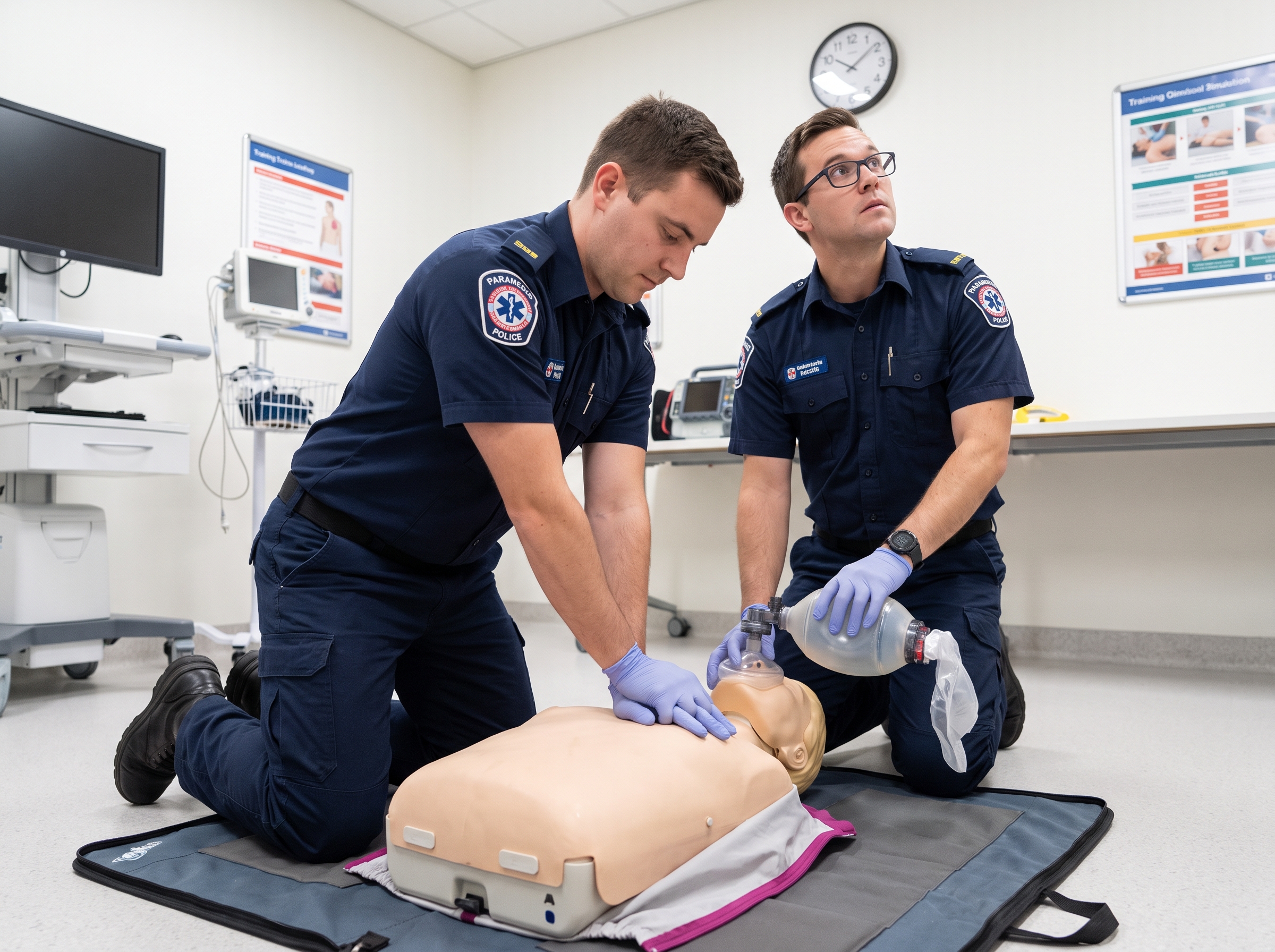
Two rescuers performing two-rescuer adult CPR with bag-valve mask ventilation


There is a reason the adult ratio never splits by rescuer count the way the pediatric ratio does. Adult sudden cardiac arrest is more often driven by a primary cardiac or electrical event, so the priority throughout the resuscitation leans toward maximizing time spent compressing rather than increasing ventilation frequency. Keeping one ratio for every adult scenario also removes a decision point during a moment when providers are already tracking rhythm checks, medication timing, and AED readiness.


Child and Infant CPR Ratios: Where 30:2 Becomes 15:2

Pediatric ratios start out matching the adult number. A single rescuer performing CPR on a child, roughly age one to puberty, or an infant under age one, uses the same 30:2 ratio as an adult: thirty compressions, two breaths, repeat. This is intentional. Teaching one ratio for every lone-rescuer scenario, regardless of the patient's age, reduces the number of decisions a single provider has to make while also trying to phone for help, retrieve an AED, and maintain compression quality without a partner to share the workload. The single-rescuer pediatric cardiac arrest algorithm walks through this exact sequence, including when to activate emergency response before or after the first two minutes of CPR.


The ratio changes as soon as a second trained rescuer is available to take over ventilations. In a two-rescuer child or infant resuscitation, the compression to ventilation ratio drops to 15:2: fifteen compressions, two breaths. According to the American Heart Association's pediatric basic life support and CPR quality guidance, this shift reflects how often pediatric arrests originate from a respiratory problem rather than a primary cardiac event, so more frequent ventilation earlier in the resuscitation carries more clinical weight than it typically does in adult arrest. The multi-rescuer pediatric cardiac arrest algorithm covers the full sequence, including role assignment and when a third rescuer should retrieve the AED or pediatric pads.


Infants add a technique wrinkle on top of the ratio change. With two rescuers present, the compressing provider switches from the single-rescuer two-finger or one-hand technique to the two thumb-encircling hands technique, wrapping both hands around the infant's chest with thumbs positioned over the lower half of the sternum while the second rescuer maintains the airway and delivers breaths at the 15:2 ratio. This technique tends to generate more consistent depth and is only practical once a second set of hands is free to manage the airway rather than help compress. The two-rescuer pediatric BLS algorithm covers the hand positioning and timing side by side with the ratio itself.


One judgment call worth flagging: the child versus adult ratio cutoff is not a strict birthday, it is the onset of puberty. A large adolescent who has reached puberty is treated with the adult 30:2 ratio and adult compression targets, even if their chart age would technically still fall under a pediatric algorithm elsewhere. Providers are trained to make this call based on physical presentation in the moment, not a lookup of the patient's exact age, which is part of why the ratio table is organized around developmental stage rather than birthdate alone.


Why the Ratio Changes: The Physiology Behind 30:2 vs 15:2

It is worth understanding why the number flips instead of just memorizing that it does. Compression to ventilation ratios of 30:2 and 15:2 were chosen deliberately to balance two competing priorities: keeping interruptions in chest compressions short, and delivering enough ventilation to matter clinically. For adults, where cardiac arrest is more often a primary electrical or ischemic event, the priority leans toward minimizing interruptions, so a single ratio of 30:2 applies regardless of rescuer count. For children and infants, where hypoxia and respiratory failure are common precipitating causes, adding a second rescuer creates the opportunity to ventilate more frequently without sacrificing compression quality, since the rescuer managing the airway no longer has to divide attention between compressions and breaths.


This tradeoff connects directly to a concept called chest compression fraction: the percentage of total resuscitation time that a patient actually spends receiving compressions. Every pause for ventilation, every rescuer rotation, and every rhythm check chips away at that fraction, and resuscitation science consistently ties a higher compression fraction to better odds of a good outcome. The chest compression fraction guide goes deeper into how ratio choice, rescuer rotation, and pause discipline all feed into this single number.


This is also why ratio and rescuer count are taught together instead of separately. A provider who memorizes "30:2" or "15:2" as an isolated fact, without connecting it to who is present and what is driving the arrest, is more likely to apply the wrong number under stress. Anchoring the ratio to the clinical reasoning behind it, cardiac origin versus respiratory origin, single provider versus shared workload, tends to hold up better than rote memorization alone once an actual code is underway.


Compression Rate and Depth: What Stays the Same Across Every Ratio

While the ratio changes by age and rescuer count, the compression rate does not. Current American Heart Association guidance on high-quality CPR calls for a rate of 100 to 120 compressions per minute for adults, children, and infants alike, whether the cycle in progress is 30:2, 15:2, or continuous compressions after an advanced airway is placed. Rate tends to be the number providers recall accurately under pressure; it is depth and ratio switching where performance most often drifts.


Depth targets do change by age, and they scale to body size rather than to the ratio in use. Adults need at least 2 inches (5 cm) of compression depth, without exceeding 2.4 inches (6 cm). Children need about one third of the chest's anterior-posterior diameter, which in practice lands around 2 inches (5 cm) for most school-age children. Infants need roughly one third of their smaller chest diameter, or about 1.5 inches (4 cm). Research published in the American Heart Association's journal, including a comparison of relative and actual chest compression depths in children and adolescents, has examined how well these proportional targets translate into real compressions across different body sizes, which is part of why pediatric depth is taught as a range and a landmark rather than a single fixed number.
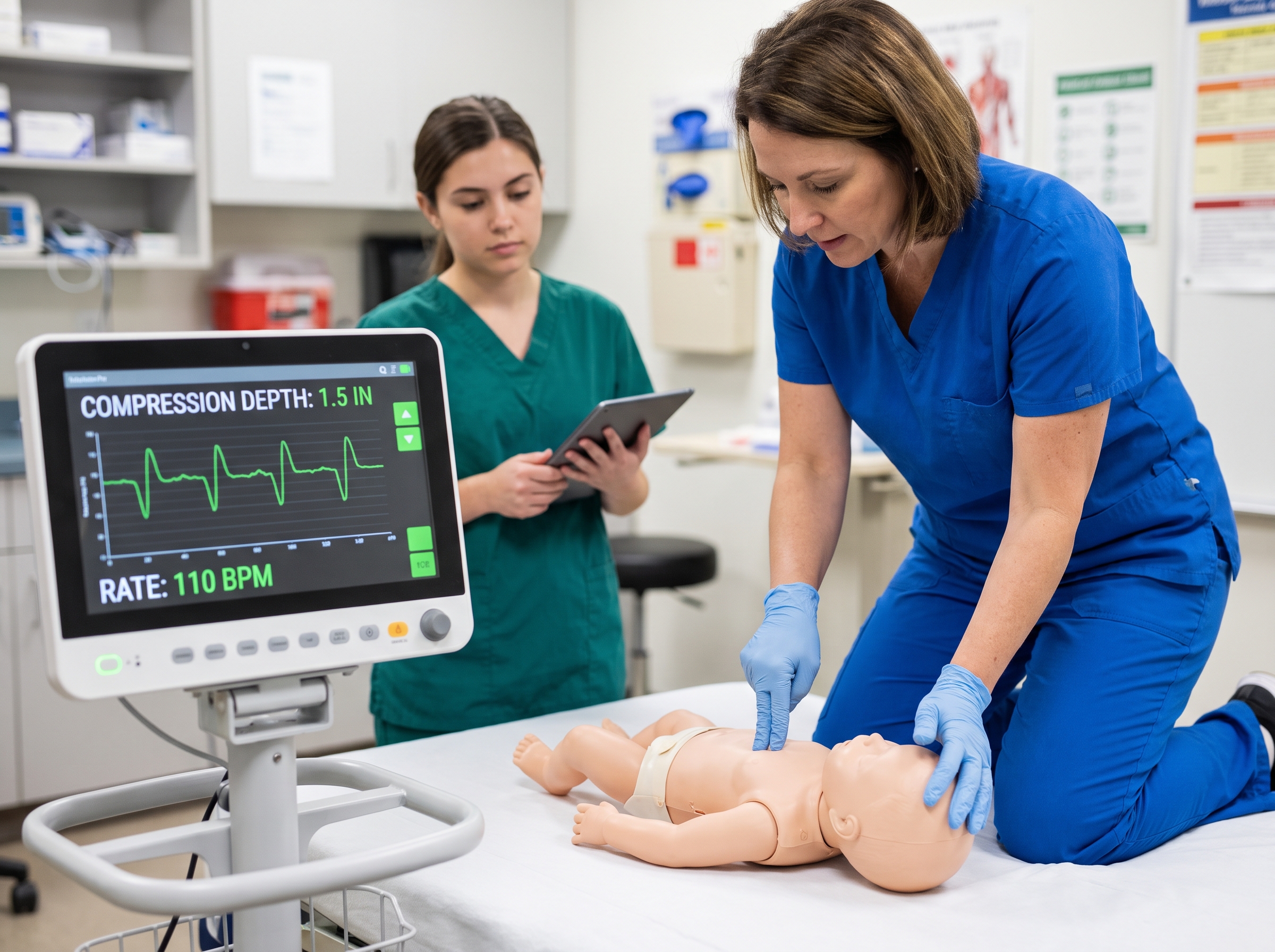
Instructor demonstrating infant CPR compression depth and hand placement


In practice, rate and depth are easier to self-correct than ratio. A rescuer who feels themselves slowing down can consciously speed back up, and many training mannequins and feedback devices give real-time depth cues. Ratio errors are harder to catch mid-cycle because they are a counting problem, not a force or timing problem, which is exactly why a quick reference like this one is worth reviewing before a shift or an exam rather than only during one.


When an Advanced Airway Changes the Math

Every ratio discussed so far assumes a basic airway: a bag-valve mask, a pocket mask, or mouth-to-mouth ventilation paused between sets of compressions. Once an advanced airway, an endotracheal tube or a supraglottic device, is placed during cardiac arrest, the ratio-based approach is set aside entirely. The compressing rescuer delivers continuous chest compressions at 100 to 120 per minute with no pauses for ventilation, while the rescuer managing the airway delivers one breath approximately every 6 seconds, which works out to about 10 breaths per minute, asynchronously with the compressions. This is one of the most commonly missed points on advanced provider exams, because it is tempting to keep counting to 30 out of habit even after the airway is secured.


The rationale mirrors the same interruption-minimizing logic behind the 30:2 and 15:2 ratios, just carried further. The American Heart Association's focused update on advanced airway management during cardiac arrest reinforces that once an advanced airway secures ventilation independent of compressions, there is no longer a clinical reason to interrupt compressions for breaths, so continuous compressions become both possible and preferred. Manikin-based ventilation research, including a study on minute ventilation at different compression to ventilation ratios and ventilation rates, has helped inform how rescue breath timing and volume are taught once compressions no longer pause for ventilation at all.


One exception is worth remembering for exam purposes and real practice alike. If ventilation cannot be delivered effectively while compressions continue, for example if chest rise is inadequate with an asynchronous approach, brief pauses for ventilation may still be necessary. The default and preferred approach once an advanced airway is confirmed and working well is continuous compressions with asynchronous breaths, but it is a guideline built around what usually works best, not an inflexible rule that overrides clinical judgment in every airway scenario.


Common Mixups Under Pressure (and How to Avoid Them)

Ratio errors follow predictable patterns, whether on an exam station or during an actual resuscitation. Knowing the usual failure points makes them easier to catch in yourself or a teammate before they affect compression fraction or ventilation timing.


  • Applying 15:2 to an adult. The 15:2 ratio is a pediatric, two-rescuer number only. Adults stay at 30:2 no matter how many rescuers are present.
  • Forgetting to switch when a second rescuer joins a pediatric arrest already in progress. If you started alone at 30:2 and a trained partner arrives, the ratio changes to 15:2 as soon as that partner takes over ventilations, not at the start of the next full cycle.
  • Continuing to count breath cycles after an advanced airway is placed. Once the tube or supraglottic device is confirmed and secured, stop pausing compressions for breaths. Compressions run continuously, and breaths run on their own clock of about once every 6 seconds.
  • Letting rescuer rotation slow the ratio down. Switching compressors should happen in the time it takes to deliver the two breaths in the cycle, not as a separate pause tacked on afterward.
  • Using adult hand position and technique on an infant out of habit. The ratio and the technique travel together. A 15:2 infant cycle with two rescuers pairs with the two thumb-encircling hands technique, not the adult two-hand heel-of-palm method.
  • Treating rate and ratio as the same number. The compression rate of 100 to 120 per minute never changes. Only the ratio, how many compressions happen before the pause for breaths, changes by age and rescuer count.


Keep These Ratios Sharp Long Before You Need Them

Reading a quick reference table is a fine start, but ratio recall under real stress comes from repetition, not memorization. Run through each scenario out loud: adult single rescuer, adult two rescuer, pediatric single rescuer, pediatric two rescuer, and the advanced airway switch, until the numbers come without hesitation and without having to stop and calculate.


If you train or work alongside other providers, practice the handoff moments specifically: the rescuer switch in adult two-rescuer CPR, the ratio change the instant a second rescuer joins a pediatric arrest, and the transition to continuous compressions once an airway is secured. Those transition points, not the steady-state cycles, are where most ratio errors actually happen, and they are also the moments a megacode evaluator or a real code team is watching most closely.


If your BLS card is due for renewal or you are certifying for the first time, building these ratios into muscle memory is exactly what a hands-on refresher is for. Affordable ACLS's self-paced BLS certification and recertification course covers every ratio in this reference alongside the full adult and pediatric algorithms, so you can study on your own schedule and walk into your next exam station or code without second-guessing the numbers.


The Bottom Line

Three rules cover nearly every CPR ratio question you will face. Adults are always 30:2, regardless of rescuer count. Children and infants start at 30:2 alone and drop to 15:2 the moment a second trained rescuer takes over ventilations. And once an advanced airway is in place, ratios stop applying altogether in favor of continuous compressions paired with breaths delivered on their own clock. Keep this reference handy, practice the transition points rather than just the steady-state numbers, and the ratios will hold up whether you are being tested on a megacode station or called to the bedside for the real thing.


ACLS Blogs

CPR Ratios by Age: When 30:2 Becomes 15:2 (Quick Reference)

CPR Ratios by Age: Why 30:2 and 15:2 Both Matter

Ask any BLS or PALS student to name the compression to ventilation ratio for CPR, and the answer usually comes fast: 30:2. Ask a follow-up question about a two-rescuer pediatric arrest, and the confidence often wavers. That hesitation is exactly where points get lost on a megacode station and where seconds get lost during an actual code. This quick reference lays out every compression to ventilation ratio you need by age and rescuer count, along with the compression rate, compression depth, and advanced airway rules that travel with them, all sourced to current American Heart Association guidance.


Here is the short version before the full breakdown. Adults always use a 30:2 ratio, whether one rescuer is present or two. Children and infants also start at 30:2 for a single rescuer, but the moment a second trained rescuer arrives to take over ventilations, the pediatric ratio changes to 15:2. Once an advanced airway is placed, ratios disappear entirely in favor of continuous compressions paired with breaths delivered on their own clock. Bookmark the table below, then read on for the reasoning behind each number so it holds up under pressure, not just on a study sheet.


This reference is built for BLS and PALS students studying for a certification exam, working providers who want a fast refresher before a shift, and anyone brushing up before a recertification deadline. The ratios below apply specifically to CPR performed on a patient in cardiac arrest, meaning no pulse and no normal breathing. Rescue breathing for a patient who still has a pulse but is not breathing adequately follows a different rate and is outside the scope of this particular reference.


CPR Ratio Quick Reference Table

The table below is built to be scanned in seconds, whether during a study session or a pre-shift refresher. For the full decision-point sequencing behind each scenario, from checking responsiveness through AED application, keep the BLS Algorithms Hub bookmarked alongside this ratio card.


Population Rescuers Compression to Ventilation Ratio Compression Rate Compression Depth Adult Single rescuer 30:2 100 to 120 per minute At least 2 inches (5 cm), no more than 2.4 inches (6 cm) Adult Two rescuers 30:2 100 to 120 per minute At least 2 inches (5 cm), no more than 2.4 inches (6 cm) Child (about age 1 to puberty) Single rescuer 30:2 100 to 120 per minute About 2 inches (5 cm), or one third of chest depth Child (about age 1 to puberty) Two rescuers 15:2 100 to 120 per minute About 2 inches (5 cm), or one third of chest depth Infant (under age 1) Single rescuer 30:2 100 to 120 per minute About 1.5 inches (4 cm), or one third of chest depth Infant (under age 1) Two rescuers 15:2 100 to 120 per minute About 1.5 inches (4 cm), or one third of chest depth Any age Advanced airway in place No ratio, continuous compressions 100 to 120 per minute, plus 1 breath about every 6 seconds Age-appropriate depth as above

Adult CPR Ratios: One Number for Every Rescuer Scenario

Adult CPR keeps the ratio simple. Whether you are the only rescuer on scene or working with a partner, the compression to ventilation ratio for an adult in cardiac arrest is 30:2: thirty chest compressions followed by two rescue breaths, repeated in cycles. The compression rate stays between 100 and 120 per minute, and the depth target is at least 2 inches (5 cm) without exceeding 2.4 inches (6 cm), for the entire sequence. If you want the full decision tree that surrounds this ratio, from initial pulse checks to AED timing and rhythm reassessment, the adult cardiac arrest algorithm guide walks through every step in order.


What changes with two rescuers is not the ratio, it is the workflow around it. One rescuer stays at the chest delivering compressions while the other manages the airway and delivers breaths, and the two switch roles roughly every five cycles, or about every two minutes, to prevent compressor fatigue from degrading compression quality later in the resuscitation. Counting out loud, minimizing the pause before and after each set of breaths, and rotating without breaking rhythm are the skills that actually get tested in a two-rescuer scenario, not the ratio itself. The two-rescuer BLS technique guide breaks down the choreography, including when to call for a rotation and how to hand off compressions without losing compression fraction.

Two rescuers performing two-rescuer adult CPR with bag-valve mask ventilation


There is a reason the adult ratio never splits by rescuer count the way the pediatric ratio does. Adult sudden cardiac arrest is more often driven by a primary cardiac or electrical event, so the priority throughout the resuscitation leans toward maximizing time spent compressing rather than increasing ventilation frequency. Keeping one ratio for every adult scenario also removes a decision point during a moment when providers are already tracking rhythm checks, medication timing, and AED readiness.


Child and Infant CPR Ratios: Where 30:2 Becomes 15:2

Pediatric ratios start out matching the adult number. A single rescuer performing CPR on a child, roughly age one to puberty, or an infant under age one, uses the same 30:2 ratio as an adult: thirty compressions, two breaths, repeat. This is intentional. Teaching one ratio for every lone-rescuer scenario, regardless of the patient's age, reduces the number of decisions a single provider has to make while also trying to phone for help, retrieve an AED, and maintain compression quality without a partner to share the workload. The single-rescuer pediatric cardiac arrest algorithm walks through this exact sequence, including when to activate emergency response before or after the first two minutes of CPR.


The ratio changes as soon as a second trained rescuer is available to take over ventilations. In a two-rescuer child or infant resuscitation, the compression to ventilation ratio drops to 15:2: fifteen compressions, two breaths. According to the American Heart Association's pediatric basic life support and CPR quality guidance, this shift reflects how often pediatric arrests originate from a respiratory problem rather than a primary cardiac event, so more frequent ventilation earlier in the resuscitation carries more clinical weight than it typically does in adult arrest. The multi-rescuer pediatric cardiac arrest algorithm covers the full sequence, including role assignment and when a third rescuer should retrieve the AED or pediatric pads.


Infants add a technique wrinkle on top of the ratio change. With two rescuers present, the compressing provider switches from the single-rescuer two-finger or one-hand technique to the two thumb-encircling hands technique, wrapping both hands around the infant's chest with thumbs positioned over the lower half of the sternum while the second rescuer maintains the airway and delivers breaths at the 15:2 ratio. This technique tends to generate more consistent depth and is only practical once a second set of hands is free to manage the airway rather than help compress. The two-rescuer pediatric BLS algorithm covers the hand positioning and timing side by side with the ratio itself.


One judgment call worth flagging: the child versus adult ratio cutoff is not a strict birthday, it is the onset of puberty. A large adolescent who has reached puberty is treated with the adult 30:2 ratio and adult compression targets, even if their chart age would technically still fall under a pediatric algorithm elsewhere. Providers are trained to make this call based on physical presentation in the moment, not a lookup of the patient's exact age, which is part of why the ratio table is organized around developmental stage rather than birthdate alone.


Why the Ratio Changes: The Physiology Behind 30:2 vs 15:2

It is worth understanding why the number flips instead of just memorizing that it does. Compression to ventilation ratios of 30:2 and 15:2 were chosen deliberately to balance two competing priorities: keeping interruptions in chest compressions short, and delivering enough ventilation to matter clinically. For adults, where cardiac arrest is more often a primary electrical or ischemic event, the priority leans toward minimizing interruptions, so a single ratio of 30:2 applies regardless of rescuer count. For children and infants, where hypoxia and respiratory failure are common precipitating causes, adding a second rescuer creates the opportunity to ventilate more frequently without sacrificing compression quality, since the rescuer managing the airway no longer has to divide attention between compressions and breaths.


This tradeoff connects directly to a concept called chest compression fraction: the percentage of total resuscitation time that a patient actually spends receiving compressions. Every pause for ventilation, every rescuer rotation, and every rhythm check chips away at that fraction, and resuscitation science consistently ties a higher compression fraction to better odds of a good outcome. The chest compression fraction guide goes deeper into how ratio choice, rescuer rotation, and pause discipline all feed into this single number.


This is also why ratio and rescuer count are taught together instead of separately. A provider who memorizes "30:2" or "15:2" as an isolated fact, without connecting it to who is present and what is driving the arrest, is more likely to apply the wrong number under stress. Anchoring the ratio to the clinical reasoning behind it, cardiac origin versus respiratory origin, single provider versus shared workload, tends to hold up better than rote memorization alone once an actual code is underway.


Compression Rate and Depth: What Stays the Same Across Every Ratio

While the ratio changes by age and rescuer count, the compression rate does not. Current American Heart Association guidance on high-quality CPR calls for a rate of 100 to 120 compressions per minute for adults, children, and infants alike, whether the cycle in progress is 30:2, 15:2, or continuous compressions after an advanced airway is placed. Rate tends to be the number providers recall accurately under pressure; it is depth and ratio switching where performance most often drifts.


Depth targets do change by age, and they scale to body size rather than to the ratio in use. Adults need at least 2 inches (5 cm) of compression depth, without exceeding 2.4 inches (6 cm). Children need about one third of the chest's anterior-posterior diameter, which in practice lands around 2 inches (5 cm) for most school-age children. Infants need roughly one third of their smaller chest diameter, or about 1.5 inches (4 cm). Research published in the American Heart Association's journal, including a comparison of relative and actual chest compression depths in children and adolescents, has examined how well these proportional targets translate into real compressions across different body sizes, which is part of why pediatric depth is taught as a range and a landmark rather than a single fixed number.

Instructor demonstrating infant CPR compression depth and hand placement


In practice, rate and depth are easier to self-correct than ratio. A rescuer who feels themselves slowing down can consciously speed back up, and many training mannequins and feedback devices give real-time depth cues. Ratio errors are harder to catch mid-cycle because they are a counting problem, not a force or timing problem, which is exactly why a quick reference like this one is worth reviewing before a shift or an exam rather than only during one.


When an Advanced Airway Changes the Math

Every ratio discussed so far assumes a basic airway: a bag-valve mask, a pocket mask, or mouth-to-mouth ventilation paused between sets of compressions. Once an advanced airway, an endotracheal tube or a supraglottic device, is placed during cardiac arrest, the ratio-based approach is set aside entirely. The compressing rescuer delivers continuous chest compressions at 100 to 120 per minute with no pauses for ventilation, while the rescuer managing the airway delivers one breath approximately every 6 seconds, which works out to about 10 breaths per minute, asynchronously with the compressions. This is one of the most commonly missed points on advanced provider exams, because it is tempting to keep counting to 30 out of habit even after the airway is secured.


The rationale mirrors the same interruption-minimizing logic behind the 30:2 and 15:2 ratios, just carried further. The American Heart Association's focused update on advanced airway management during cardiac arrest reinforces that once an advanced airway secures ventilation independent of compressions, there is no longer a clinical reason to interrupt compressions for breaths, so continuous compressions become both possible and preferred. Manikin-based ventilation research, including a study on minute ventilation at different compression to ventilation ratios and ventilation rates, has helped inform how rescue breath timing and volume are taught once compressions no longer pause for ventilation at all.


One exception is worth remembering for exam purposes and real practice alike. If ventilation cannot be delivered effectively while compressions continue, for example if chest rise is inadequate with an asynchronous approach, brief pauses for ventilation may still be necessary. The default and preferred approach once an advanced airway is confirmed and working well is continuous compressions with asynchronous breaths, but it is a guideline built around what usually works best, not an inflexible rule that overrides clinical judgment in every airway scenario.


Common Mixups Under Pressure (and How to Avoid Them)

Ratio errors follow predictable patterns, whether on an exam station or during an actual resuscitation. Knowing the usual failure points makes them easier to catch in yourself or a teammate before they affect compression fraction or ventilation timing.


  • Applying 15:2 to an adult. The 15:2 ratio is a pediatric, two-rescuer number only. Adults stay at 30:2 no matter how many rescuers are present.
  • Forgetting to switch when a second rescuer joins a pediatric arrest already in progress. If you started alone at 30:2 and a trained partner arrives, the ratio changes to 15:2 as soon as that partner takes over ventilations, not at the start of the next full cycle.
  • Continuing to count breath cycles after an advanced airway is placed. Once the tube or supraglottic device is confirmed and secured, stop pausing compressions for breaths. Compressions run continuously, and breaths run on their own clock of about once every 6 seconds.
  • Letting rescuer rotation slow the ratio down. Switching compressors should happen in the time it takes to deliver the two breaths in the cycle, not as a separate pause tacked on afterward.
  • Using adult hand position and technique on an infant out of habit. The ratio and the technique travel together. A 15:2 infant cycle with two rescuers pairs with the two thumb-encircling hands technique, not the adult two-hand heel-of-palm method.
  • Treating rate and ratio as the same number. The compression rate of 100 to 120 per minute never changes. Only the ratio, how many compressions happen before the pause for breaths, changes by age and rescuer count.


Keep These Ratios Sharp Long Before You Need Them

Reading a quick reference table is a fine start, but ratio recall under real stress comes from repetition, not memorization. Run through each scenario out loud: adult single rescuer, adult two rescuer, pediatric single rescuer, pediatric two rescuer, and the advanced airway switch, until the numbers come without hesitation and without having to stop and calculate.


If you train or work alongside other providers, practice the handoff moments specifically: the rescuer switch in adult two-rescuer CPR, the ratio change the instant a second rescuer joins a pediatric arrest, and the transition to continuous compressions once an airway is secured. Those transition points, not the steady-state cycles, are where most ratio errors actually happen, and they are also the moments a megacode evaluator or a real code team is watching most closely.


If your BLS card is due for renewal or you are certifying for the first time, building these ratios into muscle memory is exactly what a hands-on refresher is for. Affordable ACLS's self-paced BLS certification and recertification course covers every ratio in this reference alongside the full adult and pediatric algorithms, so you can study on your own schedule and walk into your next exam station or code without second-guessing the numbers.


The Bottom Line

Three rules cover nearly every CPR ratio question you will face. Adults are always 30:2, regardless of rescuer count. Children and infants start at 30:2 alone and drop to 15:2 the moment a second trained rescuer takes over ventilations. And once an advanced airway is in place, ratios stop applying altogether in favor of continuous compressions paired with breaths delivered on their own clock. Keep this reference handy, practice the transition points rather than just the steady-state numbers, and the ratios will hold up whether you are being tested on a megacode station or called to the bedside for the real thing.


blogs

More articles for you

all articles

Start Today!

Get certified at your own pace, on your schedule, from the comfort of your home.