ACLS Blogs

AHA Guideline Changes for 2026: What ACLS Providers Need to Know Now

If you last thought hard about AHA guidelines back when you read our roundup of the key changes in ACLS guidelines for 2025, it is time for an update. The document ACLS providers are actually working from in 2026 is the 2025 American Heart Association Guidelines for Cardiopulmonary Resuscitation and Emergency Cardiovascular Care, published in Circulation in October 2025 - the first full revision of the guidelines since 2020. Training centers spent the final months of 2025 and the opening months of 2026 rolling updated material into ACLS, BLS, and PALS courses, which means the algorithm you memorized at your last renewal may already be a step behind what your instructor teaches at your next one. This is a practical, no-fluff walkthrough of what actually changed, what stayed the same, and what it means for your next recertification.


Why 2026 Feels Like a Guideline Reset

Guideline updates usually arrive in small, focused doses - a single algorithm tweak, one new drug recommendation. Not this cycle. According to the executive summary published in Circulation, the 2025 Guidelines represent the first comprehensive revision of the entire CPR and ECC guideline set since 2020, built on the 2025 International Liaison Committee on Resuscitation (ILCOR) Consensus on Science with Treatment Recommendations. Instead of one isolated change, ACLS providers are absorbing new guidance across defibrillation strategy, airway timing, vascular access, several medication recommendations, and post-cardiac arrest care, all in the same update cycle.


That rollout is not abstract. According to the American Heart Association's course updates page, official change notices for updated ACLS, BLS, and PALS course materials went out to AHA Training Centers in December 2025 and again in February 2026. If your last course predates those notices, some of what you learned is already outdated, not because you missed something, but because the guidelines moved. We covered the mechanics of how these revisions ripple into classroom content in our piece on the impact of recent guideline updates on ACLS, BLS, and PALS courses, and this article is the 2026-specific follow-up to that groundwork.

Healthcare team reviewing updated AHA resuscitation guidelines together


How These Updates Actually Get Made

It helps to understand the pipeline behind a change like this, because it explains why the guidance carries weight instead of being one organization's opinion. ILCOR pulls together resuscitation councils from around the world to review the published evidence and issue a Consensus on Science with Treatment Recommendations, the CoSTR referenced above. The American Heart Association's writing groups then translate that international consensus into the specific guidelines used in the United States, which is the document AHA Training Centers use to build ACLS, BLS, and PALS course material. That is also why a change does not show up in your classroom the same week it is published. There is a translation step between "the evidence changed" and "your instructor is teaching it differently," and that gap is exactly what created the December 2025 and February 2026 change notices mentioned earlier.


Knowing that pipeline matters for a practical reason: it tells you where to look when you want the primary source instead of a secondhand summary, including this one. If a claim about a guideline change seems off, the Circulation guideline papers and the AHA's own guidelines pages are the place to verify it, not a forum post or a course vendor's marketing page.


One Chain of Survival Instead of Several

One of the more visible structural changes is conceptual rather than clinical: the 2025 Guidelines consolidate what used to be separate chains of survival for adult, pediatric, in-hospital, and out-of-hospital cardiac arrest into a single unified chain, according to the American Heart Association newsroom summary. The individual links (recognition and activation, immediate high-quality CPR, rapid defibrillation, advanced resuscitation, and post-arrest care) are still there. What changed is the framing: one continuum of care that applies whether the patient is an adult or a child, and whether the arrest happens in a hospital bed or a grocery store aisle. For code teams that manage both adult and pediatric events, that consistency simplifies training and debriefing.


Adult Advanced Life Support: The Changes You Will Feel Most

This is the section most relevant to day-to-day ACLS practice. The AHA's Adult Advanced Life Support guidance updates several pieces of the algorithm you run during a code. None of it is a complete rewrite, but several defaults have shifted enough to matter.


Defibrillation: Single Shocks, Not Stacked

The guidelines continue to favor biphasic waveforms and a single-shock strategy rather than stacked shocks, with CPR resuming immediately after each shock rather than pausing to reassess the rhythm repeatedly. Higher energy for the second and subsequent shocks may be considered, though the writing group is candid that the optimal escalation pattern is still not settled. Vector change and double sequential defibrillation remain in "not established" territory: there is limited supportive evidence, but not enough for a routine recommendation. One point is stated without hedging: polymorphic ventricular tachycardia is always considered unstable and should be treated immediately with defibrillation, because any delay in shock delivery worsens outcomes.


Airway Management: Compressions Come First

The airway sequencing guidance is one of the more practical shifts for code teams. If placing an advanced airway will interrupt chest compressions, current guidance is to defer that insertion until the patient has failed to respond to initial CPR and defibrillation attempts. In other words, a bag-mask device and uninterrupted compressions come first; the endotracheal tube or supraglottic airway can wait a beat. When an advanced airway is in place, the guidance calls for continuous compressions with roughly 10 breaths per minute, avoiding hyperventilation, and titrating oxygen to a target SpO2 of 94 to 99 percent rather than defaulting to 100 percent oxygen.
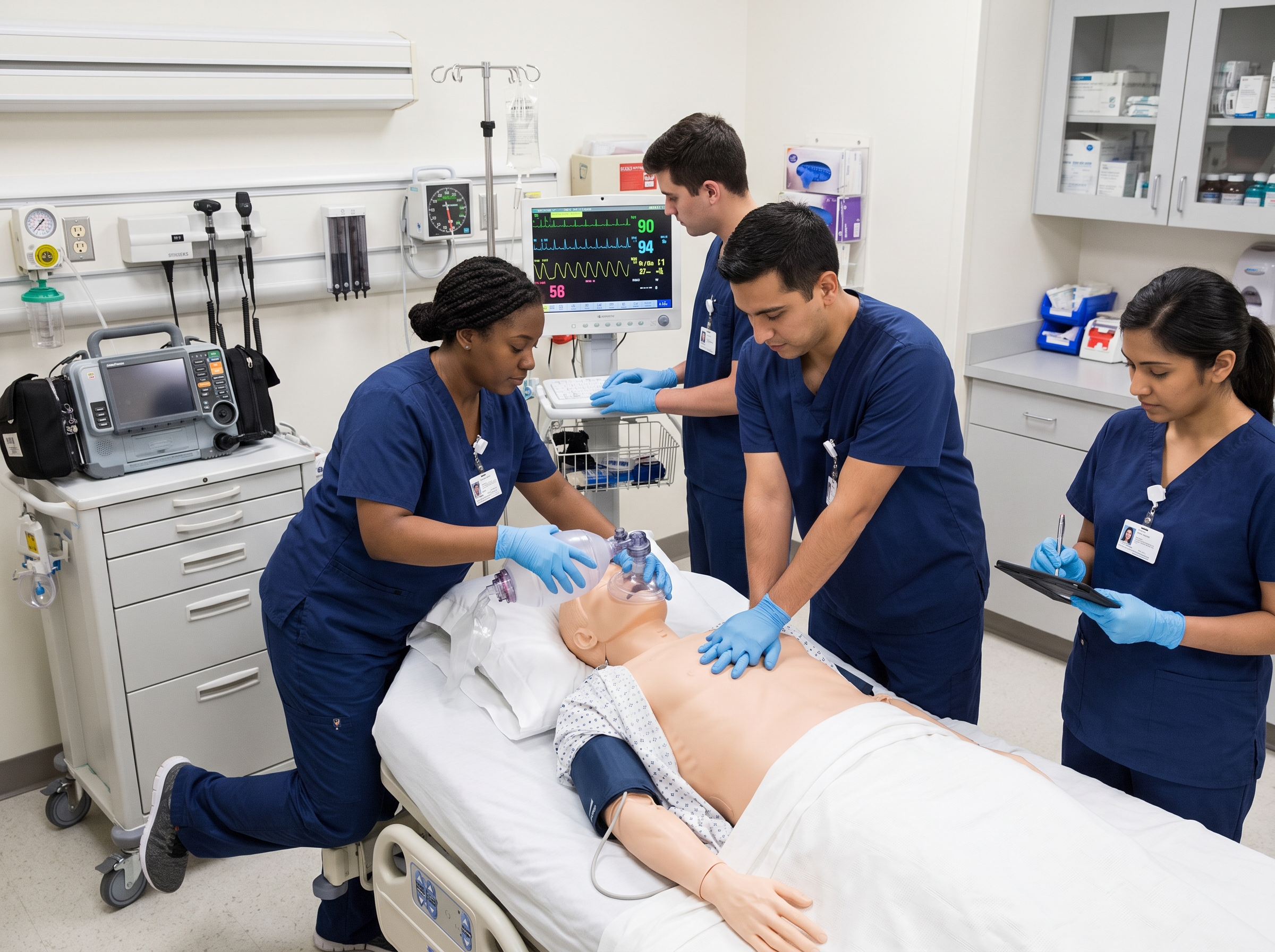
Code team using bag-valve-mask ventilation while performing uninterrupted chest compressions


Either a supraglottic airway or an endotracheal tube is considered acceptable, with the choice depending on team training and first-pass success rates rather than a blanket preference for one device. The guidelines also quietly retire an old practice: intra-arrest medication administration through an endotracheal tube is no longer part of the recommendations, reflecting the shift toward IV and IO access as the standard routes.


Vascular Access: IV Still First, IO Clearly Acceptable

Intravenous access remains the first-line route, but intraosseous access is now described as reasonable if initial IV attempts are unsuccessful, rather than as a fallback used only when IV access has clearly failed. Recent large trials found no meaningful outcome difference between the two approaches, which is why the language moved from an IV-preferred stance to a more flexible one. In practice, this validates what a lot of busy code teams were already doing: going to IO quickly rather than repeatedly attempting a difficult IV stick.


Medications: One Timing Nuance, a Few Confirmed No's

Standard-dose epinephrine (1 mg every 3 to 5 minutes) remains the core recommendation, and a higher initial dose is not supported by the new guidelines. The timing detail worth noting: for a shockable rhythm, it is now reasonable to give epinephrine after initial defibrillation attempts have failed, prioritizing rapid defibrillation over reflexively pushing epinephrine on the first pass. For nonshockable rhythms, the guidance is unchanged: give epinephrine as soon as feasible.


Elsewhere in the drug box, the picture is mostly confirmation rather than new territory. Vasopressin offers no advantage over epinephrine alone. Calcium, sodium bicarbonate, and magnesium are not recommended for routine use during cardiac arrest outside of specific reversible-cause scenarios. Amiodarone or lidocaine may still be considered for shock-refractory VF or pulseless VT. If you want the dosing, routes, and indications for all of this in one place before your next renewal, our ACLS medications cheat sheet lays it out by algorithm.


Termination of Resuscitation: More Nuance, Not a Shortcut

The guidelines also introduce more stratified termination-of-resuscitation rules based on EMS scope of practice: a BLS TOR rule for basic life support providers, an ALS TOR rule for advanced providers, and a Universal TOR rule for tiered systems where both levels respond. One safeguard is explicit: end-tidal CO2 should not be used in isolation to decide when to stop resuscitative efforts. It has to be considered alongside other clinical findings, not as a single cutoff number. Point-of-care ultrasound may be considered to help identify reversible causes, but only if it can be done without interrupting compressions. Head-up CPR, meanwhile, is not recommended outside of clinical trials, so it is not something you should expect to see standardized into your next course.


Post-Cardiac Arrest Care Gets More Structure

The 2025 post-cardiac arrest care guideline adds more specificity to what happens after return of spontaneous circulation: initial blood pressure targets, oxygenation and ventilation goals, and glucose control all get clearer parameters than in the 2020 version. The guidance also weighs the evidence on routine antibiotic use after ROSC, appropriate diagnostic testing, temperature control goals and duration, and when percutaneous coronary intervention or mechanical circulatory support are appropriate.


If your facility's post-arrest bundle has not been updated in a while, this is the section to revisit first, since it affects the hours immediately following a save, not just the code itself. Our guides on what happens after the heart starts beating again and on targeted temperature management protocols walk through the practical side of post-ROSC cooling and monitoring in more depth than a single course session usually allows.


What Else Changed Around You (Even If It Is Not Your Algorithm)

ACLS providers rarely work in isolation from BLS and PALS content, especially if you supervise codes, run mock drills, or train newer staff. A few changes outside the strict ACLS algorithm are worth knowing about because they will show up in the courses around you. Choking management guidance now calls for alternating five back blows with five abdominal thrusts in conscious adults and children, and for infants, alternating back blows with chest thrusts rather than abdominal thrusts, due to injury risk.


There is also a new algorithm addressing suspected opioid overdose, including public-access guidance on when to use naloxone, given that opioids are involved in roughly 80 percent of drug overdose deaths globally according to the American Heart Association. On the lay-rescuer side, evidence now supports teaching effective CPR and defibrillation to children as young as 12, part of a broader push toward community training after data showed only about 41 percent of out-of-hospital cardiac arrest victims receive bystander CPR before EMS arrives.


What This Means If You Are Recertifying This Year

If your card expires in the next few months, the practical question is simple: will your renewal course reflect this update? Course content built on the 2025 Guidelines is already the current standard, so recertifying now means training on the version of ACLS you will actually be expected to know, not the 2020 baseline. That is one of the reasons staying current matters more than usual this cycle. Our ACLS certification and recertification course is built around current AHA and ILCOR guidance, so you are not stuck cross-referencing a course written for the previous edition of the guidelines against a newsroom summary on your phone between patients.


If you are specifically due for renewal rather than starting from scratch, the ACLS recertification course is built for exactly that situation: providers who already know the fundamentals and need an efficient, guideline-current refresher rather than a first-time deep dive. And if the idea of skills fading between renewal cycles sounds familiar, our piece on why ACLS skills decay between recertifications covers how to keep the muscle memory sharp in the months between courses, which matters even more when the underlying algorithm has shifted.


Do You Need to Recertify Early Because of This?

Short answer: no, not just because the guidelines updated. A guideline revision does not retroactively invalidate a certification card that is still inside its printed expiration date, and employers accept a current card regardless of which guideline edition was in effect when you took the course. What the update does mean is that your next renewal, whenever it naturally falls, will be based on this material rather than the 2020 edition. There is no compliance emergency here, just a reason to pay closer attention at your next scheduled renewal instead of assuming the course will be identical to the last one.


The one exception worth flagging: if your card has already lapsed, or is close to it, that is a separate timeline question from the guideline update itself, and it is worth handling on its own terms rather than folding it into guideline anxiety. Either way, the course you take next will already reflect the current standard, so there is nothing extra you need to do to "catch up" beyond showing up for your normal renewal.


How to Stay Current Between Now and Your Next Renewal

You do not need to re-read the full Circulation guideline set to stay current. A few practical habits cover most of the gap between renewal cycles.


  • Confirm your card is still valid. Existing certifications remain valid through their printed expiration date. A guideline update does not invalidate a current card; it changes what your next course will teach.
  • Note the defaults that shifted. Single-shock defibrillation, deferred advanced airway placement during early CPR, IO access as a reasonable first-attempt fallback, and epinephrine timing tied to defibrillation attempts are the changes most likely to affect your next code.
  • Revisit your post-arrest bundle. Blood pressure, oxygenation, glucose, and temperature management targets all got more specific. If your facility protocol has not been reviewed since 2020, flag it for your resuscitation committee.
  • Ask your training coordinator about timing. Since AHA Training Centers received updated material in waves between December 2025 and February 2026, not every course has caught up at the same pace. It is reasonable to ask whether the course you are booking reflects the current guidelines.
  • Keep practicing between renewals. Guideline changes aside, skill decay between certifications is well documented. Short, regular practice keeps the actual performance of CPR and code leadership sharp, not just your familiarity with the algorithm on paper.


Key Takeaways

If you only remember five things from this update, make it these.


  • The 2025 AHA Guidelines for CPR and ECC, published in Circulation in October 2025, are the first full revision of the guideline set since 2020, and they are what your 2026 course is built on.
  • Defibrillation stays single-shock with immediate resumption of CPR, and polymorphic VT is always treated as unstable and shocked without delay.
  • Advanced airway placement is deferred if it would interrupt compressions, and continuous compressions with about 10 breaths per minute are the target once an advanced airway is placed.
  • Intraosseous access is now considered reasonable after unsuccessful initial IV attempts, not just as a last resort.
  • Epinephrine timing for shockable rhythms now favors giving it after initial defibrillation attempts fail, while nonshockable rhythms still call for epinephrine as soon as feasible.


None of this changes why you got certified in the first place. It just means the details underneath the algorithm are worth a fresh look before your next class, so you walk in already familiar with what is different instead of hearing it for the first time from your instructor.


ACLS Blogs

AHA Guideline Changes for 2026: What ACLS Providers Need to Know Now

If you last thought hard about AHA guidelines back when you read our roundup of the key changes in ACLS guidelines for 2025, it is time for an update. The document ACLS providers are actually working from in 2026 is the 2025 American Heart Association Guidelines for Cardiopulmonary Resuscitation and Emergency Cardiovascular Care, published in Circulation in October 2025 - the first full revision of the guidelines since 2020. Training centers spent the final months of 2025 and the opening months of 2026 rolling updated material into ACLS, BLS, and PALS courses, which means the algorithm you memorized at your last renewal may already be a step behind what your instructor teaches at your next one. This is a practical, no-fluff walkthrough of what actually changed, what stayed the same, and what it means for your next recertification.


Why 2026 Feels Like a Guideline Reset

Guideline updates usually arrive in small, focused doses - a single algorithm tweak, one new drug recommendation. Not this cycle. According to the executive summary published in Circulation, the 2025 Guidelines represent the first comprehensive revision of the entire CPR and ECC guideline set since 2020, built on the 2025 International Liaison Committee on Resuscitation (ILCOR) Consensus on Science with Treatment Recommendations. Instead of one isolated change, ACLS providers are absorbing new guidance across defibrillation strategy, airway timing, vascular access, several medication recommendations, and post-cardiac arrest care, all in the same update cycle.


That rollout is not abstract. According to the American Heart Association's course updates page, official change notices for updated ACLS, BLS, and PALS course materials went out to AHA Training Centers in December 2025 and again in February 2026. If your last course predates those notices, some of what you learned is already outdated, not because you missed something, but because the guidelines moved. We covered the mechanics of how these revisions ripple into classroom content in our piece on the impact of recent guideline updates on ACLS, BLS, and PALS courses, and this article is the 2026-specific follow-up to that groundwork.

Healthcare team reviewing updated AHA resuscitation guidelines together


How These Updates Actually Get Made

It helps to understand the pipeline behind a change like this, because it explains why the guidance carries weight instead of being one organization's opinion. ILCOR pulls together resuscitation councils from around the world to review the published evidence and issue a Consensus on Science with Treatment Recommendations, the CoSTR referenced above. The American Heart Association's writing groups then translate that international consensus into the specific guidelines used in the United States, which is the document AHA Training Centers use to build ACLS, BLS, and PALS course material. That is also why a change does not show up in your classroom the same week it is published. There is a translation step between "the evidence changed" and "your instructor is teaching it differently," and that gap is exactly what created the December 2025 and February 2026 change notices mentioned earlier.


Knowing that pipeline matters for a practical reason: it tells you where to look when you want the primary source instead of a secondhand summary, including this one. If a claim about a guideline change seems off, the Circulation guideline papers and the AHA's own guidelines pages are the place to verify it, not a forum post or a course vendor's marketing page.


One Chain of Survival Instead of Several

One of the more visible structural changes is conceptual rather than clinical: the 2025 Guidelines consolidate what used to be separate chains of survival for adult, pediatric, in-hospital, and out-of-hospital cardiac arrest into a single unified chain, according to the American Heart Association newsroom summary. The individual links (recognition and activation, immediate high-quality CPR, rapid defibrillation, advanced resuscitation, and post-arrest care) are still there. What changed is the framing: one continuum of care that applies whether the patient is an adult or a child, and whether the arrest happens in a hospital bed or a grocery store aisle. For code teams that manage both adult and pediatric events, that consistency simplifies training and debriefing.


Adult Advanced Life Support: The Changes You Will Feel Most

This is the section most relevant to day-to-day ACLS practice. The AHA's Adult Advanced Life Support guidance updates several pieces of the algorithm you run during a code. None of it is a complete rewrite, but several defaults have shifted enough to matter.


Defibrillation: Single Shocks, Not Stacked

The guidelines continue to favor biphasic waveforms and a single-shock strategy rather than stacked shocks, with CPR resuming immediately after each shock rather than pausing to reassess the rhythm repeatedly. Higher energy for the second and subsequent shocks may be considered, though the writing group is candid that the optimal escalation pattern is still not settled. Vector change and double sequential defibrillation remain in "not established" territory: there is limited supportive evidence, but not enough for a routine recommendation. One point is stated without hedging: polymorphic ventricular tachycardia is always considered unstable and should be treated immediately with defibrillation, because any delay in shock delivery worsens outcomes.


Airway Management: Compressions Come First

The airway sequencing guidance is one of the more practical shifts for code teams. If placing an advanced airway will interrupt chest compressions, current guidance is to defer that insertion until the patient has failed to respond to initial CPR and defibrillation attempts. In other words, a bag-mask device and uninterrupted compressions come first; the endotracheal tube or supraglottic airway can wait a beat. When an advanced airway is in place, the guidance calls for continuous compressions with roughly 10 breaths per minute, avoiding hyperventilation, and titrating oxygen to a target SpO2 of 94 to 99 percent rather than defaulting to 100 percent oxygen.

Code team using bag-valve-mask ventilation while performing uninterrupted chest compressions


Either a supraglottic airway or an endotracheal tube is considered acceptable, with the choice depending on team training and first-pass success rates rather than a blanket preference for one device. The guidelines also quietly retire an old practice: intra-arrest medication administration through an endotracheal tube is no longer part of the recommendations, reflecting the shift toward IV and IO access as the standard routes.


Vascular Access: IV Still First, IO Clearly Acceptable

Intravenous access remains the first-line route, but intraosseous access is now described as reasonable if initial IV attempts are unsuccessful, rather than as a fallback used only when IV access has clearly failed. Recent large trials found no meaningful outcome difference between the two approaches, which is why the language moved from an IV-preferred stance to a more flexible one. In practice, this validates what a lot of busy code teams were already doing: going to IO quickly rather than repeatedly attempting a difficult IV stick.


Medications: One Timing Nuance, a Few Confirmed No's

Standard-dose epinephrine (1 mg every 3 to 5 minutes) remains the core recommendation, and a higher initial dose is not supported by the new guidelines. The timing detail worth noting: for a shockable rhythm, it is now reasonable to give epinephrine after initial defibrillation attempts have failed, prioritizing rapid defibrillation over reflexively pushing epinephrine on the first pass. For nonshockable rhythms, the guidance is unchanged: give epinephrine as soon as feasible.


Elsewhere in the drug box, the picture is mostly confirmation rather than new territory. Vasopressin offers no advantage over epinephrine alone. Calcium, sodium bicarbonate, and magnesium are not recommended for routine use during cardiac arrest outside of specific reversible-cause scenarios. Amiodarone or lidocaine may still be considered for shock-refractory VF or pulseless VT. If you want the dosing, routes, and indications for all of this in one place before your next renewal, our ACLS medications cheat sheet lays it out by algorithm.


Termination of Resuscitation: More Nuance, Not a Shortcut

The guidelines also introduce more stratified termination-of-resuscitation rules based on EMS scope of practice: a BLS TOR rule for basic life support providers, an ALS TOR rule for advanced providers, and a Universal TOR rule for tiered systems where both levels respond. One safeguard is explicit: end-tidal CO2 should not be used in isolation to decide when to stop resuscitative efforts. It has to be considered alongside other clinical findings, not as a single cutoff number. Point-of-care ultrasound may be considered to help identify reversible causes, but only if it can be done without interrupting compressions. Head-up CPR, meanwhile, is not recommended outside of clinical trials, so it is not something you should expect to see standardized into your next course.


Post-Cardiac Arrest Care Gets More Structure

The 2025 post-cardiac arrest care guideline adds more specificity to what happens after return of spontaneous circulation: initial blood pressure targets, oxygenation and ventilation goals, and glucose control all get clearer parameters than in the 2020 version. The guidance also weighs the evidence on routine antibiotic use after ROSC, appropriate diagnostic testing, temperature control goals and duration, and when percutaneous coronary intervention or mechanical circulatory support are appropriate.


If your facility's post-arrest bundle has not been updated in a while, this is the section to revisit first, since it affects the hours immediately following a save, not just the code itself. Our guides on what happens after the heart starts beating again and on targeted temperature management protocols walk through the practical side of post-ROSC cooling and monitoring in more depth than a single course session usually allows.


What Else Changed Around You (Even If It Is Not Your Algorithm)

ACLS providers rarely work in isolation from BLS and PALS content, especially if you supervise codes, run mock drills, or train newer staff. A few changes outside the strict ACLS algorithm are worth knowing about because they will show up in the courses around you. Choking management guidance now calls for alternating five back blows with five abdominal thrusts in conscious adults and children, and for infants, alternating back blows with chest thrusts rather than abdominal thrusts, due to injury risk.


There is also a new algorithm addressing suspected opioid overdose, including public-access guidance on when to use naloxone, given that opioids are involved in roughly 80 percent of drug overdose deaths globally according to the American Heart Association. On the lay-rescuer side, evidence now supports teaching effective CPR and defibrillation to children as young as 12, part of a broader push toward community training after data showed only about 41 percent of out-of-hospital cardiac arrest victims receive bystander CPR before EMS arrives.


What This Means If You Are Recertifying This Year

If your card expires in the next few months, the practical question is simple: will your renewal course reflect this update? Course content built on the 2025 Guidelines is already the current standard, so recertifying now means training on the version of ACLS you will actually be expected to know, not the 2020 baseline. That is one of the reasons staying current matters more than usual this cycle. Our ACLS certification and recertification course is built around current AHA and ILCOR guidance, so you are not stuck cross-referencing a course written for the previous edition of the guidelines against a newsroom summary on your phone between patients.


If you are specifically due for renewal rather than starting from scratch, the ACLS recertification course is built for exactly that situation: providers who already know the fundamentals and need an efficient, guideline-current refresher rather than a first-time deep dive. And if the idea of skills fading between renewal cycles sounds familiar, our piece on why ACLS skills decay between recertifications covers how to keep the muscle memory sharp in the months between courses, which matters even more when the underlying algorithm has shifted.


Do You Need to Recertify Early Because of This?

Short answer: no, not just because the guidelines updated. A guideline revision does not retroactively invalidate a certification card that is still inside its printed expiration date, and employers accept a current card regardless of which guideline edition was in effect when you took the course. What the update does mean is that your next renewal, whenever it naturally falls, will be based on this material rather than the 2020 edition. There is no compliance emergency here, just a reason to pay closer attention at your next scheduled renewal instead of assuming the course will be identical to the last one.


The one exception worth flagging: if your card has already lapsed, or is close to it, that is a separate timeline question from the guideline update itself, and it is worth handling on its own terms rather than folding it into guideline anxiety. Either way, the course you take next will already reflect the current standard, so there is nothing extra you need to do to "catch up" beyond showing up for your normal renewal.


How to Stay Current Between Now and Your Next Renewal

You do not need to re-read the full Circulation guideline set to stay current. A few practical habits cover most of the gap between renewal cycles.


  • Confirm your card is still valid. Existing certifications remain valid through their printed expiration date. A guideline update does not invalidate a current card; it changes what your next course will teach.
  • Note the defaults that shifted. Single-shock defibrillation, deferred advanced airway placement during early CPR, IO access as a reasonable first-attempt fallback, and epinephrine timing tied to defibrillation attempts are the changes most likely to affect your next code.
  • Revisit your post-arrest bundle. Blood pressure, oxygenation, glucose, and temperature management targets all got more specific. If your facility protocol has not been reviewed since 2020, flag it for your resuscitation committee.
  • Ask your training coordinator about timing. Since AHA Training Centers received updated material in waves between December 2025 and February 2026, not every course has caught up at the same pace. It is reasonable to ask whether the course you are booking reflects the current guidelines.
  • Keep practicing between renewals. Guideline changes aside, skill decay between certifications is well documented. Short, regular practice keeps the actual performance of CPR and code leadership sharp, not just your familiarity with the algorithm on paper.


Key Takeaways

If you only remember five things from this update, make it these.


  • The 2025 AHA Guidelines for CPR and ECC, published in Circulation in October 2025, are the first full revision of the guideline set since 2020, and they are what your 2026 course is built on.
  • Defibrillation stays single-shock with immediate resumption of CPR, and polymorphic VT is always treated as unstable and shocked without delay.
  • Advanced airway placement is deferred if it would interrupt compressions, and continuous compressions with about 10 breaths per minute are the target once an advanced airway is placed.
  • Intraosseous access is now considered reasonable after unsuccessful initial IV attempts, not just as a last resort.
  • Epinephrine timing for shockable rhythms now favors giving it after initial defibrillation attempts fail, while nonshockable rhythms still call for epinephrine as soon as feasible.


None of this changes why you got certified in the first place. It just means the details underneath the algorithm are worth a fresh look before your next class, so you walk in already familiar with what is different instead of hearing it for the first time from your instructor.


blogs

More articles for you

all articles

Start Today!

Get certified at your own pace, on your schedule, from the comfort of your home.